

John Steinbeck- NHÀ HOANG (phần 1)
nguyên tác The Grapes of Wrath
dịch thuật: Đinh Trọng Phúc
hình ảnh và chú thích của người dịch

"Họ cần phải sống trước khi còn đủ khả năng lo liệu cho cái chết "
(They got to live before they can afford to die / Grapes of Wrath)
***

Mục sư Jim Casy cùng Joad Con đứng trên đồi nhìn xuống khu vực gia đình Joad. Căn nhà chẳng hề sơn phết lại mất đi một góc. Cái nhà hình như đã bị một sức tàn phá nào đó đẩy nó khỏi cái nền nên sập về một hướng. Khung cửa sổ còn sót chơ vơ nổi bật lên đường chân trời. Mấy cái hàng rào cũng chẳng còn. Cây bông mọc lên trong vườn ngay ngôi nhà đó. Bông mọc sát cái chuồng bị sập. Căn nhà nát vẫn còn vị trí, nhưng bông mọc um tùm gần như che luôn nó. Vườn xưa đâu từng âm vang tiếng chân bầy trẻ nô đùa, tiếng vó ngựa dồn dập mỗi lúc về chuồng cùng tiếng bánh xe lăn kẻo kẹt? Giờ này có ai đã canh tác ngay trên nền đất xưa, những lùm là bông xanh đậm, đầy bụi bậm đang mọc dưới kia? Tom trố mắt nhìn khá lâu vào bụi liễu tả tơi cạnh cái máng ngựa khô rang nằm tại cái nền xi măng mà nơi đó cái bơm nước.
Joad kêu lên:
-Chúa Ôi !
-Có chuyện gì xảy ra nơi đây rồi sao không còn ai ở đó ?
Than xong anh ta bươn bả xuống đồi, thầy Casy cũng vội chạy theo. Cái mái kho, trống không, một ít rơm khô còn sót lại trên nền và đằng cái chuồng lừa đằng góc kia. Anh vừa nhòm vào trong thì bầy chuột nhốn nháo chạy núp vào dưới rơm. Anh dừng lại một lát trước mái vào mái che đựng đồ dùng, không còn thứ nào ở đây- một cuộn cỏ khô còn sót lại đằng góc kia. Một cái vòng sắt từ cái cào cỏ, một cái choàng cổ cho la bị chuột gặm, một thùng dầu đã cạn chỉ còn một lớp cặn bẩn đầy bụi lóng lại, và một bộ áo treo đã rách còn móc trên chiếc đinh.
-Chẳng còn gì cả !
Thầy Casy lên tiếng
-Nếu như ta vẫn còn là người thầy ta sẽ thưa Chúa Toàn Năng sao không với tay cứu người . Giờ ta không biết chuyện gì. Ta xa lâu rồi nên chẳng biết chuyện gì nơi đây.
Cả hai đi tới cái giếng ống bê tông, có nắp, rồi chạy thẳng ra cánh đồng bông xem cho rõ.
Nhiều nùi bông bắt đầu ra , rõ ràng đất này đang được ai canh tác .
-Nhà con chưa bao giờ trồng thứ gì nơi này, -Joad giải thích
-Chỗ này, gia đình con luôn để trống. Ủa sao lại không thấy dấu ngựa nào qua vạt bông này cả?
Họ dừng lại nơi cái máng khô nước, không có cây cỏ dại nào mọc nỗi dưới đáy cái máng gỗ nứt nẻ . Trên miệng cái giếng, mấy chốt sắt giữ cần bơm, vươn cao; những sợi dây rỉ, mấy cái chốt cũng mất. Joad nhìn sâu vào giếng, thử hét to xong lắng nghe tiếng vọng . Anh thả thêm một viên đá xuống giếng, nghe động tĩnh.
-Giếng này trước đây ngon lắm thầy à -anh nói như nhắc lại với chính mình.
-Nhưng sao không nghe tiếng nước dội lại ?
Hơi lưỡng lự, Tom không dám bước vào căn nhà trống. Anh tiếp tục thả thêm nhiều hòn đá xuống giếng, giọng có vẻ bấn loạn:
-Có thể gia đình con chết hết rồi !
-Nhưng có người bảo có ai nhắn gì con mà?
-Có thể nguòi nhà con để lại bức thư nào đó hay làm dấu gì đó trong căn nhà này chăng ? không biết họ hay tin con ra tù chưa ?
-Chẳng biết nữa.
Giọng Tom buồn rầu.
-Con đoán có thể do nhà con chưa hề hay tin về con. Cách đây đúng một tuần chính con cũng chưa hay con sẽ được thả nữa thầy à !
-Thôi chúng ta gắng vào trong hẳn hay . Cái nhà này gần sụm đến nơi. Giống thứ gì tông vào thì phải ?
Hai người bước rón rén vào trong căn nhà lung lay. Hai cột hiên gãy mất làm phần đầu mái sụm xuống. Một góc nhà bị cán nát. Họ nhìn xuyên qua khoảng hở, thấy rõ nhiều ván gỗ lổm chổm, lòi ra ngoài vách tường. Cửa trước mở vào trong. Cái cổng thấp phía trước nhà bật ra phía ngoài còn treo lủng lẳng nhờ vào mấy chiếc đai da.
Joad chợt dừng lại nơi bậc cấp, đóng bằng loại gỗ 12x12.
-Đây là bậc cấp- đúng rồi -anh lẩm bẩm, nhưng mọi người đều mất dạng, hay MÁ đã chết?
Anh chỉ tay vào cái cổng lủng lẳng phía ngoài, kể trong thoáng mắt trìu mến
-Thường MÁ đi đâu, cái cổng phải đóng và móc lại kia mà, đây là việc MÁ luôn làm. Bà xem lại xem chắc chắn là đóng chưa mới đi.
- Kể từ ngày con heo lọt vào nhà gia đình Jacob, nhai sống đứa bé. Gia đình Jacobs chỉ vừa đi ra cái vựa thì MÁ vừa vào và cùng lúc thấy con heo đang nhai đứa bé. Ôi, gia đình Jacobs chỉ lanh quanh trong nhà thôi, con heo đó bỗng hóa điên dại. Chuyện đau lòng không ai quên. MÁ không bao giờ quên bài học đớn đau kia. Bà không bao giờ dám để cửa chuồng heo mở ngoại trừ khi bà có mặt trong nhà. Không bao giờ quên được.
Không, cả nhà đã đi xa hay chết hết rồi?
Anh trèo lên cái mái hiên bị tách, nhìn vào nhà bếp. Cửa sổ vỡ nát, những viên gạch rơi nằm la liệt. Nền cùng tường nhà rời xa ra khỏi cửa vào nhà, bụi đất phủ đầy các mặt ván.
Joad giờ chỉ vào đống ly vụn cùng gạch đá.
Joad đoán...lũ trẻ nghịch thường đi xa tới hai mươi dặm tới đây để đập vở những cửa sổ này, vì nó biết là nhà không có ai, con đoán vậy. Thật là tụi phá hoại khi nhà con vắng hết.

Căn bếp nay không còn đồ đạc. Cái ống bếp trên vách lộ ánh sáng bên ngoài. Trong bồn rửa chén còn lại cái mở bia cũ, một cái nĩa gãy, mất cái tay cầm gỗ. Joad cẩn thận trườn người vào phòng trong. Nền nhà rên rỉ dưới sức nặng của anh. Anh nhìn ra cuốn Philadelphia Ledger cũ nằm trên sàn nhà đối trước bức tường. Mấy trang giấy giờ ố vàng, cong queo. Joad gắng nhìn sâu vào phòng ngủ-không giường ghế, không mọi thứ. Trên tường còn sót lại bức hình màu người con gái Da Đỏ, đề Red Wing. Một giường sắt dựa vào tường, góc kia còn chiếc giày cao cổ đàn bà sót lại, một đằng mũi hở lên, đằng cổ giày đã rách . Joad lượm chiếc giày lên, ngắm nghía:
-Con nhớ rồi, đây là chiếc giày của MÁ, giờ vứt đây. Bao năm MÁ con rất thích mang loại này. Vậy là cả nhà đã đi xa rồi !
Mặt trời xuống thấp ngoài cửa sổ, le lói ánh sáng còn lại, phản chiếu vào mấy mảnh thủy tinh. Joad xuyên qua mái hiên quay ra. Anh ngồi xuống, để đôi chân trần nghỉ trên cái tầng cấp nhà loại cây gỗ 12x12 . Nắng chiều như vương vấn trên cánh đồng. Những hàng bông trải bóng dài trên mặt đất; bụi liễu xơ xác cũng nghiêng cái bóng đơn độc theo ánh chiều buông.
Thầy Casy giờ ngồi cạnh Joad, gặn hỏi:
-Nhà con không ghi lại gì cho con sao?
-Không thầy ạ, như con nói trước đây, nhà con không phải hạng người sinh ra để viết. Pa viết được nhưng ông không muốn, cũng chẳng bao giờ thích viết. Ba con viết đẹp chẳng kém ai, nhưng ông chả thèm viết một chữ.
Hai người ngồi bên nhau, cùng nhìn về phía xa. Joad đặt cuốn áo bên cạnh. Rảnh tay, anh vấn điếu thuốc, xong châm lửa hút. Anh hít một hơi dài, nhả khói qua lỗ mũi .
-Có gì không ổn, con hiểu được lý do rồi. Con chắc nhà con đã gặp điều rất xấu. Thầy xem, nhà xiêu vách nát xung quanh và ai cũng bỏ đi hết ?
Thầy Casy chợt nhớ ra:
-Ngay mương nước đằng kia, nơi ta làm lễ rửa tội. Con chẳng hiểu gì ngoài nghịch ngợm. Con cứ đeo theo cô gái có cái bím tóc chẳng khác gì con chó đực. Ta rửa tội cho hai con theo tinh thần Đức Thánh Linh khi con cứ mê mẩn với cô ta. Ta nhớ Già Tom thốt lên 'Thánh Linh và con tôi dưới nước' thế là ta dúi đầu con sâu dưới nước cho đến khi con súi bong bóng và chịu thả cái bím tóc kia ra. Không phải con quá tinh nghịch, nhưng con cứng đầu. Đôi khi đứa trẻ cứng đầu lớn lên với nỗi thất vọng tinh thần to lớn bên trong không chừng.

Một con mèo xám trông dáng xấu xí bò ra khỏi cái vựa cũ, rón rén bò tới hàng bông sát mái hiên. Nó nhảy phóc lên mái hiên một cách êm thắm rồi mon men tới gần hai người. Nó bò tới đằng sau và khoảng giữa hai người, rồi rón rén ngồi xuống. Đuôi nó duỗi dài nằm sát nền nhà, phần cuối đuôi mãi ngúc ngoắc. Mèo và người cùng nhìn về một hướng, khoảng xa nào đó trước mặt. Joad liếc nhanh về con mèo
-Chúa ôi, vẫn còn thứ ở lại đây này, thầy coi này!
Nói xong anh vói tay ra tới nó. Con mèo nhảy tránh tầm tay anh, xong ngồi xuống thủng thẳng liếm bàn chân đang giương móng. Joad nhìn kỹ con mèo, mặt bối rối:
-con biết -anh phân bua-con mèo này giúp con đoán ra chuyện gì rồi thầy ơi!
- Theo ta hình như có nhiều chuyện chẳng lành , thầy Casy phụ họa.
-Điều chẳng lành không phải duy nhất nhà con đâu thầy. Tại sao con mèo này không tới ở nhà hàng xóm, như gia đình Ranch chẳng hạn? Sao không ai thèm tới tháo gỗ ở nhà này? Ba bốn tháng nay chắc không ai còn ở xóm này, không còn người để tới đây trộm gỗ, những miếng ván đẹp ngoài mái vựa kia chẳng có ai tháo cả. Rõ ràng không đúng, điều này làm con lo vô cùng, con không thể hiểu được.
- Theo con đoán là gì ?
Thầy Casy cúi xuống tháo đôi giày thể thao ra xong luồn mấy ngón chân dài ông ta dưới bậc cấp gỗ kia.
-Con không biết. Coi bộ hàng xóm chẳng ai ở lại. Nếu còn ai sao còn mấy tấm ván đẹp này tại nhà này hả? Giêsu ơi, Albert Rance đã dời gia đình, con cái, chó mèo và tất cả dọn tới Oklahoma City vào một mùa Giáng Sinh lâu rồi. Có thể bà con của Albert họ đi tìm nhau. Ôi, xóm làng chê trách nhà Albert ra đi không nói một lời, đàn bà thì tìm cách chửi ông một trận. Ông ta dọn nhà, tuần sau về lại vơ vét hết không còn thứ gì, bếp -giường , khung cửa sổ , gỗ tám đều vơ đi sạch đến nỗi ai cũng nhìn trống hốc. Ông đến và lái đi thì vừa lúc gia đình Muley Graves mới rời khỏi nhà kia cùng cái máy bơm. Nhà Albert mất hết hai tuần lui tới vùng này để lấy về mọi thứ .
Thầy Casy mãi mê gãi ngứa ngón chân của mình:
-Thế không ai chống lại ông đó, để ông ta lấy đi mọi thứ kia ư?
-Đúng, họ đâu có lấy cắp. Họ cho là họ để đó và trở lui lấy lại thôi. Ông ta lấy lui hết, ngoại trừ cái sofa có gối, tấm nhung với hình cái bình của người Da đỏ trên đó. ALbert nài nĩ ÔNG NỘI giữ giúp do ông nghĩ Nội có máu da đỏ trong người. Tốt, Nội đã giữ giúp, nhưng Nội chẳng cần quái gì hình cái hình người da đỏ trên đó. Ông chỉ cần tấm nhung này cuốn lại cho êm khi ngồi thôi. Ông chẳng bao giờ trả cái gối lại cho Albert. Nội còn nói: ‘Nếu Albert ngu ngốc về đòi lại cái gối này cứ về, hắn sẽ ăn viên đạn ta bắn vào cái đầu thối tha nếu hắn léng phéng gần cái gối !’
Cuối cùng Albert chịu thua, xem như cái gối kia làm quà cho Grampa. Nội lại có cái ý dồn lông gà để làm nên cái giường hôi hám toàn lông gà! Một ngày Pa tức điên người do con chồn cứ rình rập dưới sàn nhà và Pa đã đập con chồn bằng cây gỗ 2x4, còn Má thì đốt hết lông gà của Nội để có thể ở yên trong nhà. Pa cười ' Ông NỘi thật là ông già kỳ cục, cứ viết trên cái gối kia ' tại sao để Albert cứ tới đây lấy lại' Pa còn nói, ‘ta sẽ vặn cổ thằng khốn kia quăng ra ngoài như lôi cái ngăn kéo vậy’.
Con mèo giờ mới dám bò gần tới hai người, cái đuôi dài vẫn rà sát mặt nền mấy cái ria nhúc nhích lên xuống. Mặt trời giờ đã xuống thấp tận chân trời làn không khí bụi bậm đẫm hai màu đỏ và vàng kim loại. Mèo giờ đã dám cào vào đùm áo của Joad như dò xét thứ gì?
-Ôi nãy giờ mình quên khuấy con rùa. Chẳng nên gói nó kỹ và lâu quá như thế này.
Joad mở ngay đùm áo, thả con rùa đất xuống nền nhà. Lạ thay, chỉ một giây thôi con rùa lại nhắm về hướng tây nam y lúc đầu nó bị bắt. Chú mèo phóng tới đánh chận vào cần cổ đang vươn dài cùng chận mấy cái chân đang bò nhanh của con rùa. Cái đầu già nua xấu xí cứng ngắt con rùa giờ thụt vào, cùng lúc cái đuôi to cụt cũng rút vào trong mai. Chú mèo giờ chán cảnh chờ đợi nên bước đi. Chỉ có thế, con rùa lại vội bò nhanh về hướng tây nam.
Joad và người thầy đạo chăm chú nhìn con rùa bỏ trốn. Bốn chân nó bươn bả cố mang vòm mai nặng nề chạy cho được về hướng tây nam. Chú mèo giờ lại bò theo, nhưng khoảng hơn chục yards nó lại uốn cong cái lưng lên chẳng khác gì một chiếc cung đang căng, ngáp dài, rón rén trở lui lại gần hai người đang ngồi.
-Thầy đoán ra Ba con đi tới cái xó nào không thầy?
-Con nghĩ đời con chẳng khác gì mấy con rùa này, đi khắp nơi khắp chốn, nhưng cuối cùng cũng muốn trở về thôi.

Con mèo xám vẫn ngồi ở giữa hai người, phía sau họ. Hai con mắt hơi nhấp nháy. Vùng da ở hai vai nó hơi co giật về trước xong co lại do con bọ nào làm nó ngứa ngáy. Mèo lại đưa một chân lên, dùng vuốt gãi tìm ở chỗ ngứa. Nó vươn mấy cái vuốt ra xong co lại coi bộ thành thục. Nó lại le cái lưỡi hồng nhạt liếm miếng da dưới bàn chân.
Mặt trời đỏ lòm giờ lặn ngang đường chân trời cùng hắt lên nhiều tia sáng trông chẳng khác gì hình ảnh con sứa. Bầu trời bên trên sáng hơn, sinh động hơn bao giờ. Joad lấy đôi giày mới đang gói ở trong chiếc áo ra, phủi sơ bụi mang lại vào chân….

Muley Graves trong phim kịch nghệ
The Grapes of Wrath 1940
Thầy Casy nhìn về hướng cánh đồng, bỗng lên tiếng:
- Hình như có ai đang đi về đây, đang lũi qua đám bông đằng kia kìa?
Joad vội nhìn theo ngón tay ông.
-Họ đi chân, bụi bốc lên khó nhìn quá. Quái ai vậy?
Hai người chăm chú nhìn một bóng người tiến lại trong ánh chiều. Mặt trời đang lặn, nhuốm đỏ đám bụi bốc lên từ xa.
-Mẹ kiếp ! Joad thốt lên.
Người đàn ông tiếp tuc tiến gần hơn, bóng gã vừa ngang cái vựa, Joad nhìn ra ngay:
-Con biết người này, thầy nhớ ai không ? Muley Graves đó… chào Muley! Chú sao rồi ?
Người đàn ông tới gần rồi dừng lại. Ngạc nhiên một giây, ông ta tiến nhanh lại. Người này dáng săn chắc, hơi thấp. Động tác xem chừng nhanh nhảu, xốc vác. Túi vải đay trên tay gã, cái quần jean bạc màu nơi phần đầu gối cùng phần sau, chỗ ngồi. Chiếc áo khoác màu đã phai, lốm đốm nhiều vết dơ, hai tay áo rách nhiều nơi thụng thịu từ vai xuống, ngang cùi tay lại càng tả tơi hơn. Cái mũ đen lốm đốm dơ chẳng khác gì áo. Vành đai chiếc mũ đứt một nửa, phập phồng lên xuống theo bước chân của gã. Khuôn mặt Muley nhẳn thín chưa có nếp nhăn nào, nhưng mang nét hung dữ của một người con hư đốn nào đó. Miệng gã nhỏ, mím chặt, đôi mắt nhỏ bé phần trên mang nét cau cũng có, nóng nảy cũng có.
-Không biết thầy còn nhớ Muley không? Giọng Joad hỏi nhỏ
-Ai?
Người đó lại quát lên.
Joad im lặng. Gã tới gần, gần thêm nữa… cho đến khi rõ mặt.
-Ôi, "quỷ tha ma bắt" ta rồi!!! Tommy Joad đây mà, cháu ra tù khi nào Tommy?
-Hai ngày rồi, Joad, giọng gọn lỏn.
-Cháu đi nhờ xe thiên hạ, rồi đi bộ tới đây. Nhưng mọi người đi đâu hết rồi, bác Muley? Tại sao nhà cháu tan nát như thế này? Ai trồng bông trước nhà vậy chú Muley?
-Lạy Chúa may hôm nay ai xui ta mò ra đây!
Muley nói giọng mừng rỡ.
- Già Tom quá sợ. Khi họ đòi đuổi bà con tại đây, ta cứ ở lì tại nhà bếp đằng đó. Lạy Chúa, ta bảo họ thế, còn Già Tom ba cháu rất lo cho cháu lúc ra tù, về nhà sẽ không thấy ai. Ta không biết ông nghĩ sao nữa.
-Lúc đó ta hỏi 'Thế sao bác không ghi lại vài dòng?' Già Tom mới nói 'Tôi có nghĩ về chuyện đó, nhưng có chuyện gì nhớ coi chừng Tommy giùm giúp tôi nghe, chú ở lại đây mà'
-Ta xác định lại với cha cháu, ' tôi sẽ vĩnh viễn ở lại đây, không ai có quyền xóa tên gia đình Muley ra khỏi vùng này được, chúng sẽ chẳng làm gì được tôi đâu'.
Joad nóng ruột:
-Nhưng nhà cháu ở đâu? hãy nói chuyện đó sau, chú cho cháu biết mau lên, nhà cháu đâu rồi?!

-Ôi, cả nhà cháu coi bộ chống đến cùng. Lúc ngân hàng sai máy cày tới ủi nhà cậu. Ông nội cháu cầm súng đứng ra chống lại, bắn bay cái đèn trước, nhưng xe cứ tiếp tục cày. Ông cháu không muốn giết gã lái máy cày do hắn là Willy Feeley. Willy biết thế nên cứ làm tới. Hắn lái ầm ầm cày vào nhà. Ôi ! Già Tom ‘đứt ruột bầm gan’, ông không còn giống xưa nữa .
Joad phát cáu :
-Nhưng cả nhà cháu đâu rồi mới được chứ?
-Ta nói cho cháu bây giờ... Họ dùng toa xe kéo của bác John cháu đi hết ba chuyến. Bếp núc, bơm nước, giường chiếu đều đem đi hết. Giường lũ trẻ cùng giường Ông Bà nội cháu, ngay cả tấm chắn trước giường đều mang theo. Thằng anh Noah của cháu ngồi vắt vẻo một bên toa, hút thuốc, hát nghêu ngao.
Miệng Joad há rộng.
-Mọi người đều ở tại nhà bác John?
- Nhà cháu ở nhà bác John. Lạ thật mọi người làm được gì tại đó? sao không gắng bám vào đây thêm chút nữa, hả chú Muley? Phải biết bám vào nhà sao lại đi? Như chú, chỉ cần nán một phút, là chú có thể làm theo điều chú muốn. Nhà cháu làm gì được nơi đó chứ?

-À, nhà cháu có thể đi làm cỏ bông (chopping cotton). Trẻ con và người già có thể cùng nhau dành tiền để tìm đường qua miền tây sinh sống. Nhà cháu cần mua chiếc xe rồi "ào" qua miền tây mà sống. Nơi đó đời sống chắc khá hơn. Vùng này chẳng còn gì. Cào cỏ bông một mẫu được trả chỉ năm mươi xu. Chao ôi ! họ còn đòi hỏi thay đổi cách làm, thế này thế kia nữa chứ ?
- Thế là nhà cháu ở yên luôn vậy hả?
-Không đâu.
- Theo chú biết thì không phải. Tin sau cùng chú hay được là cách đây bốn ngày, khi người anh Noah của cháu đi bắn thỏ, có nói có thể nhà cháu sẽ ra đi trong vòng hai tuần nữa. John biết họ sắp đi. Cháu nên tìm họ. Cách đây khoảng tám dặm, tới nhà John sẽ thấy bà con cháu ở đó. Trời ơi! họ chui rúc với nhau như lũ chuột đồng (gopher) trong hang vào mùa đông không bằng .

-Hay quá, Joad mừng rỡ.
- Những gì chú làm hiện giờ chẳng khác chút nào đối với con đường chú chọn, chú Muley à- chỉ ngược lại với con đường chú chỉ cho bà con.
Muley vẻ hơi cáu :
-Tánh cháu chẳng thay đổi. Vẫn là cậu trẻ tinh ranh ngày xưa. Sao cháu không bảo ta cách giấu mình nếu có cơ hội ?
Joad cười:
-Không, trừ phi chú muốn tự rúc đầu vào đống bể nát như kia, không ai sẽ chỉ cho chú khác hơn. Vị thầy giảng đạo này chú còn nhớ không ? Mục sư Casy đây này.
-Ô tại sao ? đúng rồi ! đúng rồi! ta không nhìn lầm, ta nhớ mặt thầy rất rõ mà.
Casy đứng dậy, hai người cùng bắt tay.
-Gặp thầy ở đây , hân hạnh cho tôi quá
Muley giọng mừng rỡ
- Lâu nay thầy đi đâu mất tiêu ?
-Ta rất cần biết...
Casy khẩn khoản
- chuyện gì xảy ra nơi này ? Sao bà con đây bị đuổi đi hết trơn thế này?
Miệng Muley mím chặt, đến nỗi cái phần nhỏ giống mỏ vẹt ở giữa môi trên phủ chụp, che luôn môi dưới, cau có:
-Tụi chó khốn nạn! tụi khốn khiếp bần tiện, Ta kể các người nghe. Ta quyết ở lại đây, coi tụi đó dám làm gì ta nào ? Nếu chúng đuổi ta đi, ta lui lại, nếu chúng thấy, ta sẽ im lặng núp dưới đất, ta sẽ vồ lấy hai ba thằng của công ty chúng.
Vừa nói ông ta vừa vỗ vào cái gì nằng nặng trong túi bên cái áo khoác.
-Ta sẽ không đi. Cha ta bám đây năm mươi năm rồi. Ta không bao giờ bỏ đi .
Tom thắc mắc:
-Lý do họ đuổi bà con chúng ta đi là sao vậy chú?

-Ồ, lý do vậy này. Cháu nhớ mấy năm trước đây bà con mình gặp phải trận Bụi Khổng Lồ (dust bowl) tàn hại mọi thứ đó chăng? Bà con đây không làm được gì, mùa màng chỉ có một tí teo (plug up an ant's ass), ai cũng mắc nợ tiền mua hàng hóa. Cháu biết như thế là sao rồi? Ôi, mấy lão chủ đất nói 'chúng tôi không còn muốn cho người thuê đất canh tác nữa, tiền tá điền, tiền trả ít quá không thấm vào đâu so khi thu đất về một mối'. Thế là họ cày hết, đuổi bà con ra đi, ngoại trừ ta. Ơn Chúa! ta không đi. Tommy, cháu biết ta chứ gì ? đời cháu sẽ nhớ mãi ta.
-Đúng Joad nói có vẻ bất đắc dĩ
… nhớ mãi suốt đời cháu mà.
-Tốt, cháu biết ta chẳng phải ngu. Ta biết vùng đất này không còn tốt. Không còn tốt nữa trừ phi dành cho chăn nuôi. Đừng nên bao giờ cày nó lên. Giờ sao người ta lại trồng hết bông ở đây. Vấn đề là cây bông đang chết rụi hết. Nếu chúng đừng đuổi ta đi, thì lúc này ta đang có mặt ở California, với tay ra là có chùm nho, hay với tay ra là có trái cam cho ta ăn rồi. Nhưng mấy’ thằng chó đẻ’ đó đòi đuổi ta đi, nói có Chúa, một nam nhi không thể nghe là thi hành ngay sao?
-Đúng! Joad phụ họa.
-Cháu ngạc nhiên tại sao Pa tuân lệnh họ dễ thế? Cháu ngạc nhiên sao ÔNG Nội không dám giết tên nào? Không ai chỉ giúp ÔNG hành động đúng lúc. MÁ cháu không phải là người dễ dàng bị ép đâu. Cháu nhớ là MÁ đã quật cho tên bán rong đồ thiếc (tin peddler),với con gà trong tay khi hắn ta gây gỗ với bà. Bà cầm con gà một tay, tay kia cầm cái rìu khi đang sắp cắt đầu nó. Bà nhắm cầm rìu chạy theo , quên mất tay nào cầm rìu lại đuổi tên ấy chạy với con gà để quất vào nó. Mất luôn con gà để ăn chỉ còn hai cái đùi trên tay bà. Chuyện này làm ÔNG cười ngất. Như vậy làm sao nhà cháu lại sợ họ?
-Ô! chuyện là thằng cha tới ăn nói ngọt như đường. Nào là 'xin các vị hãy đi, đây không phải là lỗi của tôi' ta nói ' A lỗi của ai? Tao sẽ đi tìm thằng đó !'Đó là Shawnee Land và Cattle Company tôi chỉ nhận lệnh thôi'
-Shawnee Land và Cattle Company là thằng nào ?
-Chẳng là ai cả, đó là công ty thôi.
Nói thế lại càng làm tức thêm. Không có tên nào để trút giận lên đầu nó, bà con tìm hoài cũng phát chán- chỉ trừ ta ra. Ta căm tất cả nên một mình quyết định ở lại đây thôi.

Đốm mặt trời chiều sót lại đỏ ối cuối đường chân trời, cuối cùng mất dạng . Khoảng sáng cuối cùng trên khoảnh sáng kia cũng mất theo. Mấy khoảnh mây rời rạc dưới đường chân trời, như những mảng giẻ rách đỏ chói , cũng không còn. Bóng tối mang một màu đen dần dà từ phương đông lan tới, trùm lấy cánh đồng. Sao Hôm bắt đầu lấp lánh trên nền trời đen sẩm kia. Chú mèo xám giờ lại rón rén mò về phía hướng cái vựa xong lẫn vào bóng đêm.
Joad tiếp tục:
-Ô, hôm nay chắc chúng tôi không đi nỗi tám dặm đường để tới nhà bác John đâu. Chân cháu sưng cả lên rồi. Chú có thể cho cháu tới chỗ chú được không , chú Muley? Chú ở chỉ cách đây một dặm thôi mà ?
- không hay đâu Muley bối rối.
- Không gì ăn, vợ , con, và em ta đều đi hết tới California. Họ không điên giống ta nên mới đi. Cậu thấy, ở đây có gì cho họ ăn đâu?
Thầy Casy đầu lắc lia lịa, vẻ lo ngại:
-Bác cũng phải đi thôi. Bác đừng làm gia đình phân tán như thế.
-Ta không muốn -Muley Graves cứng nhắc
-có cái gì đó níu ta bám lại đây, thầy ạ.
-Ô, Chúa ôi ! cháu đói bụng quá ! Joad kêu lên.
…bốn năm trời, bữa ăn của tôi tính từng phút. Ruột tôi hay ‘la toáng’ lên do đói. Chú Muley, chú có gì ăn không? bữa tối chú có gì vậy?

chó đồng (prairei dog).
Muley có vẻ hổ thẹn:
- Thỉnh thoảng ta ăn ếch, sóc có khi lại túm ăn cả chó đồng (prairei dog). Chuyện bất đắc dĩ mà. Giờ đây ta biết đặt bẫy thòng lọng dọc theo mấy con suối khô. Ta bẫy được nào thỏ, nào gà lôi, cáo chồn , gấu mèo… đều bị ta tóm sạch.
Ông ta khom xuống cầm cái túi xổ ra trên dưới nền. Hai xác con thỏ đuôi bông và một con thỏ đất. Xác chúng mềm nhũn, đầy lông lá nhẹ êm tuôn ra .
-Ơn Chúa ! Joad thốt lên,
…rõ ràng bốn năm rồi cháu mới thấy món thịt tươi này.
Thầy Casy cầm xác một con thỏ đuôi bông lên hỏi:
- Chúng tôi có thể ăn với bác chứ ? bác Muley Graves ?
Muley cựa quậy, vẻ lúng túng:
-đương nhiên phải mời chứ , đây là việc bắt buộc…
Ông ta dừng lại, hơi ấp úng
-Tôi không có ý, nó không phải, tôi muốn nói là ...giọng ông cứ vấp va mãi
...nếu ai đó có cái ăn trong lúc bạn lại đói- thì người thứ nhất bắt buộc phải mời như thế , tôi muốn nói, giả sử tôi lấy mấy con thỏ này trốn đi chổ khác ngồi ăn, xem có được không?
-Vâng đúng thế
Casy tán thành.
-Thầy hiểu điều đó. Tom! Muley hiểu được nhiều thật. Có những điều, đối với Muley và ngay ta đều lớn quá !
Tom xoa tay:
-ai có dao không? thôi, làm thịt mấy con vật tội nghiệp này đi !
Muley sờ trong túi quần lấy ra cái dao bỏ túi có cán bằng sừng ra đưa cho Tom. Tom bật lưỡi dao, anh đưa lên ngửi. Anh đâm lưỡi dao xuống đất, xong đâm tiếp, rồi lại ngửi lần nữa. Chùi dao vào ống quần, anh dùng ngón cái thử sờ nhẹ vào lưỡi.
Muley kéo chai nước uống, loại một lít ra khỏi ống quần, treo vào hàng hiên rồi khoe:
-Đằng ấy kiếm nước khá dễ, nhiều lắm, đầy một giếng.
Tom tay xách xác một con thỏ:
-xin một người ra hướng vựa kiếm cho một mớ kẽm gai, chúng ta dùng ván vụn và đốt lửa lên.
Anh nhìn vào xác mấy con thỏ,
- chỉ có làm thịt thỏ là lẹ nhất thôi,


thỏ đất (jackrabbit)
Tom khoét da ở lưng con thỏ tạo ra một lỗ, móc ngón tay vào anh xé da ra. Da con vật lột ra dễ dàng y cởi chiếc vớ. Miếng da lột lên ngang tận cổ, phần cẳng bị lột xuống tận móng. Joad cầm dao cắt lìa phần đầu, chân. Xong, anh đặt miếng da xuống, xẻ dọc theo xương sườn, rũ đóng ruột vào một nơi với da. Anh liệng mớ hỗn độn không ăn được vào đám cây bông gòn. Thịt thỏ giờ đã sạch, Joad cắt lìa mấy cái đùi, cắt phần thịt còn lại thành hai miếng. Joad đang bắt đầu làm con thứ hai đúng lúc thầy Casy trở vô, mớ kẽm gai trên tay.
-Nào chúng ta hãy đốt lửa lên và nướng thịt Joad hối thúc.
-Lạy chúa! nhìn những thứ này con cảm thấy đói chết lên được.
Anh hối hả chùi cùng cắt nhũng phần còn lại của mấy con thỏ xong xâu hết, treo lên sợi kẽm. Muley cùng Casy gom gỗ vụn, đốt lửa xong đóng hai cọc, cuối cùng căng xâu thịt hai đầu.
Muley bước về huớng Joad:
-Cậu để ý giùm thịt con thỏ đất (rabbit) đừng sôi bọt lên nghe. Ta chẳng bao giờ ưa thế.
Ông ta lấy trong túi quần ra cái túi vải nhỏ treo lên cổng vào.
-Lạy chúa, thịt thỏ coi như xong. Chú có muối không? Chắc chắn chú luôn mang theo nó cùng dĩa ăn và lều ngủ trong túi chứ gì?
Anh đổ muối vào tay, xát đều lên mấy miếng thịt đang treo...

Ngọn lửa giờ bốc cao hơn trước, in bóng người lên vách. Củi khô thỉnh thoảng lại nổ lốp bốp. Bầu trời toàn một màu tối đen chỉ vài ánh sao lập lòe. Chú mèo xám giờ mò ra khỏi mái vựa, lon ton chạy lại đống lửa, kêu meo meo. Nó đổi hướng vụt qua đống ruột thỏ. Con mèo ngấu nghiến nhai, nuốt vội, vài mẫu ruột lòng thòng dưới miệng.
Thầy Casy ngồi bệt gần đống lửa, ném những khúc củi vụn vào đó. Ông đẩy thanh củi dài vào khi lửa cháy gần hết. Bầy dơi lao nhanh vào ánh lửa rồi lại vụt ra. Con mèo ăn xong, uốn lưng, liếm môi, sau cùng 'rửa mặt' và xoa bộ ria của nó.
Joad cố sức giữ hai đầu sợi kẽm mang nặng mấy miếng thịt đi tới đống lửa.
Chú Muley, giữ giúp cháu một đầu mau, cuốn đầu đằng chú thật kỹ vào cọc cho. Tốt rồi! giờ căng ra. Chúng ta phải nướng cho đến lúc lửa tàn, nhưng cháu chắc không đợi kịp đâu.
Joad gắng làm sợi dây thật căng, xong kiếm cái que đẩy mấy miếng thịt trợt theo sợi dây cho ngang tầm sức nóng. Ngọn lửa liếm quanh mấy mẫu thịt. Sức nóng làm chúng săn lại, mặt ngoài ứa mỡ bóng loáng. Anh ngồi cạnh đống củi, tay không rời chiếc que đẩy phòng thịt dính cứng vào sợi kẽm.
-Chẳng khác gì buổi tiệc, Joad bỗng nhiên vui lên.
-Muối, chú Muley cũng có, nước , thịt thỏ, cháu ước gì bác có thêm một song bắp trong túi kia thì hay chừng nào chú nhỉ?
Muley trả lời qua ánh lửa bập bùng:
-Chú mày nghĩ thế làm ta cảm động, đó là cách sống của ta đó mà.
-Có gì đâu mà cảm kích, xúc động hả chú
Joad ái ngại,
…nếu chú cảm kích cháu ước gì mọi người đều biết như thế.

Muley phân trần,
-Ồ, 'ngài' ơi đây là đùa thôi. Cuộc đời ta bắt đầu rắc rối khi chúng đuổi ta ra khỏi nơi này. Đồ thối tha ! ta sắp tới để giết hết bọn chúng. Tất cả bà con đều ra đi về miền tây. Ta thì mãi lang thang. Lẩn quẩn quanh vùng này, chẳng đi đâu xa. Gặp đâu ngủ đó, như đêm nay lý do ta đến đây là tìm ngủ đây bây giờ. Có khi ta tự nhủ 'phải chăm nom mọi thứ ở đây chờ bà con trở lại' nhưng ta biết không thể nào trở thành sự thật. Còn gì đâu để ta gìn giữ. Bà con có khi nào trở lại nữa đâu. Ta chỉ biết lang thang chẳng khác gì bóng ma trong nghĩa địa.
Giờ thầy Casy mới lên tiếng:
-Bà con ở đâu lâu rồi thường luyến lưu và quen ở đó, khi đã quen một lối suy nghĩ thì khó mà ra đi lắm. Dù bây giờ ta không giảng đạo nữa, nhưng ta luôn cầu nguyện cho mọi người chứ không chỉ ngồi nghĩ về những công việc ngày qua đâu.
Joad xoay xoay miếng thịt nướng. Nước mỡ đang giọt xuống, làm bắn xèo trên lửa. Bề mặt loáng mỡ trên mặt thịt bắt đầu teo lại, cháy nám.
Joad khen rối rít :
-Ngửi này ! Lạy Chúa! xin nhìn xuống đây, thơm quá !
Muley tiếp tục chuyện ông ta:
-ta như bóng ma kinh dị trong bãi tha ma, lanh quanh khắp nơi để nhớ lại những gì ngày xưa. Có một nơi, ta nhớ giờ đã bốn mươi năm rồi; cái bụi bên khe kia, lần đầu ta nằm với người con gái lúc ta mười bốn tuổi thôi. Tay chân tháy máy, nằm thì ngáy như con nai đực, thô lỗ như con dê. Do đó ta hay tìm về nơi này nằm tưởng nhớ. Lại có một nơi như cuối cái vựa kia, nơi cha ta bị con bò rừng húc chết. Máu cha ta chảy ra lênh láng. Máu cha ta khi đó chẳng ai chùi. Ta đặt bàn tay trên đó nơi máu cha ta đã chảy xuống…
Ông dừng kể, nét mặt buồn bã,
-Các vị có thể hiểu cho tôi rằng tôi quá xúc động.
Joad trở miếng thịt, ánh mắt anh có vẻ trầm tư. Riêng thầy Casy ánh mắt đầy thuơng cảm, nhìn chăm chăm vào ánh lửa. Con mèo ăn no, giờ ngồi yên sau ba người khoảng mười lăm bộ (feet), cái đuôi xám dài thong, khoanh tới ôm gọn hai chân trước. Có con cú lớn rúc lên bay qua, ánh lửa soi lên thấy phần lông bụng màu trắng cùng đôi cánh rộng .
-Không, bác không lẻ loi đâu, nhưng cần nhất là bác đừng quá bi cảm, Joad khuyên.
Khuôn mặt loắt choắt của Muley tự nhiên đanh lại:
…lúc đó ta đặt bàn tay ta lên mặt đất nơi vũng máu còn đó. Cha ta với vết lũng ở ngực, ta thấy cha ta run lên bần bật níu vào ta, rồi ông nằm xuống tay chân chới với. Mắt cha ta chỉ còn tròng trắng như màn sữa, đầy đớn đau xong, nằm bất động mắt nhìn thẳng. Ta giờ chỉ là một thằng nhỏ đứng yên một bên, không còn biết khóc, chẳng biết gì trơ trọi.
Đầu Muley lắc mạnh .
Joad liên tục trở mấy miếng thịt.
-Rồi ta đi vào cái phòng nơi Joe ra đời. Phòng không có giường nhưng cũng là phòng. Mọi thứ đều còn đó. Joe ra đời ngay đó. Cậu ta giật mình khóc the thé, xa một dặm còn nghe tiếng. Bà Nội đứng cạnh kêu lên ‘Tuyệt quá một quý tử nữa (that's a daisy), tuyệt quá, xong rồi, xong rồi. Bà rất tự hào và uống ba ly rượu (bust three cups) qua đêm.
Joad đằng hắng :
-Chúng ta ăn được rồi.
-cho nó thật chín đã, đen hơn nữa mới ngon -Muley ra vẻ đòi hỏi
-ta muốn nói nhiều, lâu nay ta chưa nói với ai cả ,vì trong người ta quá xúc động, thật sự ta quá xúc động. giờ hết rồi. Giống như một bóng ma già trong bãi tha ma, trong bóng đêm ta đi lang thang khắp mấy căn nhà hoang lối xóm. Nào nhà của gia đình Peter, Jacobs, Rances Joad's, nhà nào cũng tối thui, giống những cái ổ chuột khốn khổ. Nhưng bọn người đó tha hồ tụ hội nhảy múa, la hét, hội họp, tha hồ vinh quang. Chúng làm đám cưới. Ta muốn xuống phố giết hết bọn chúng vì chúng đã cướp hết, cày hết, cùng đuổi sạch bà con ra khỏi nơi này. Chúng nó cướp những gì để giữ an toàn cho lợi nhuận của chúng hử? Cha ta chết gục trên mảnh đất này, thằng Joe cất tiếng khóc chào đời trên mảnh đất này, còn ta cứ vọt chạy như con dê đực từ trong bụi rậm hàng đêm. Chúng có được gì ư? Chúa chứng giám nhiều năm nay đất đai không làm được gì cả. Chẳng có được vụ nào? Nhưng mấy ‘thằng chó đẻ’ đó cứ ngồi trên bàn giấy, rồi chúng đuổi bà con đi vì mối lợi của chúng. Chúng tiếp tục đuổi hết bà con ra khỏi nơi đây rồi đem người của chúng tới đây. Bà con ly tán bơ vơ ngoài đường, chen chúc trong mấy chiếc xe và phải ra đi. Làm sao sống nỗi? Những thằng chó đẻ, ta muốn giết hết bọn chúng !

Muley Graves in the movie "The Grapes of Wrath 1939)
-Ta , ta câm nín qua lâu - tiếng ông nho nhỏ …ta lũi trốn khắp nơi chẳng khác gì một con ma già vất vưởng.
Thầy Casy đẩy thêm thanh củi dài . Ngọn lửa táp quanh vào thanh gỗ rồi tiếp tục bốc cao ngang mấy miếng thịt . Trời bên ngoài lạnh khác với sức nóng bên trong, làm căn nhà gỗ kêu răng rắc.
Thầy thì thầm :
-Ta cần phải gặp bà con đang bơ vơ trên đường. Ta cần phải thăm họ. Bà con cần giúp đỡ hơn là cần nghe giảng đạo lúc này. Họ còn sống mới còn hi vọng vào Chúa Trời chứ ? Hồn Thánh Thần nào khi hồn họ chết thảm hay buồn rầu thế kia? Họ cần giúp đỡ ngay. Họ cần phải sống trước khi còn khả năng lo liệu cho cái chết. (they got to live before they can afford to die)
Joad lo lắng kêu:
- Lạy Giêsu! hãy ăn thịt đi chứ? nó teo lại bằng con chuột nhắt rồi. Nhìn này, ngửi xem!
Anh ta chồm lên, dồn mấy miếng thịt theo sợi dây kẽm về một phía, xa ngọn lửa. Xong, anh dùng con dao của Muley cứa sâu vào những miếng thịt cho đến khi nó rời khỏi sợi dây.
-Miếng này cho Đức Thầy đây.
-Ta đã bảo, ta không là Đức Thầy nữa!
-Ô vậy thì cho Ông được không?
Nói xong Joad cứa miếng khác.
-Miếng này cho chú Muley, nhớ nguôi giận để ăn đó chú. Đây là thịt con thỏ đất chú thích. Chắc nó dai hơn thịt chó bulldog không chừng?
Tom ngồi lại, hàm răng dài cắn mạnh, xé một miếng lớn nhai ngồm ngoàm:
-Chúa Ơi ! ngon, giòn làm sao!
Tiếp tục, anh xé thêm miếng nữa, ngấu nghiến.
Muley vẫn thừ người ra ngắm phần thịt của mình:
-Lẽ ra, ta không nên thố lộ - có vẻ suy nghĩ… mà giữ kín chuyện này trong đầu.
Casy nhìn qua, miệng còn đầy thịt, những bắp thịt ở cần cổ co thắt khi nhai:
-Ông càng nói ra càng hay chúng ta dùng miệng để thố lộ nỗi buồn ra ngoài. Đôi lúc một kẻ sắp giết người dám thố lộ những điều ghê gớm, khi nó xì ra ngoài, có thể không tự biến mình là kẻ sát nhân nữa. Ông sẽ không còn giết ai nếu biết làm như thế, rất hay.
Nói xong thầy đạo cắn thêm miếng thịt nướng đang cầm trên tay.
Tom Joad thẩy miếng xương thỏ vào lửa, bật dậy, anh cắt thêm thịt còn lại đang xâu ở sợi kẽm gai. Muley nhai chậm hơn, đôi mắt nhỏ bé của ông hết nhìn người này sang người khác. Joad trái lại vồ vập, quanh miệng dính đầy mỡ.
Thật lâu, Muley nhìn sang anh, cái nhìn xem vẻ rụt rè, cánh tay cầm thịt duỗi thấp xuống .
-Tommy này !
Joad ngước lên,
-Gì chú Muley? …anh hỏi, miệng còn đầy thịt.
-Tommy này !, cháu đừng điên như ta khi cứ luôn mồm nói chuyện giết người đó nghe. Cháu chớ nên nóng nảy nghe Tom?
-Không đâu chú…Tom quả quyết …cháu dại gì mà nóng nảy. Chỉ lỡ một lần thôi.
-Chuyện đó ai cũng biết cháu không có tội mà …Muley ngắt lời
-Lão Turnbull nói sẽ thanh toán cháu khi cháu ra tù. Lão nói không ai giết được con lão ta. Bà con ở đây khuyên lão nhiều lắm.
-Tụi con say…Joad bồi hồi nhớ lại…quá say trong buổi khiêu vũ, cháu không biết vì sao nữa. Cháu chỉ biết mũi dao kia đâm vào làm cháu tỉnh cả người. Rũi cho thằng Herb, cháu thoáng thấy nó cầm dao . Sẵn cái xẽng đang dựa vào vách trường , cháu chụp lấy phang vào đầu nó. Cháu chẳng có gì thù oán với thằng Herb. Hắn tốt mà. Lúc nhỏ hắn hay đi theo chọc ghẹo chị Rosasharn, nhưng cháu cũng thích hắn chú à.
-Tốt ! bà con ai cũng khuyên nhủ cha hắn và cuối cùng ông nguôi ngoai. Có người còn nói Turnbull mang dòng máu Hatfield [1] trong người do về phía mẹ ông nên ông sẽ sống để trả thù. Ta không biết gì nhiều. Giờ ông ta và mọi người đều đi hết về California sáu tháng nay rồi.
Joad, Jim Casy
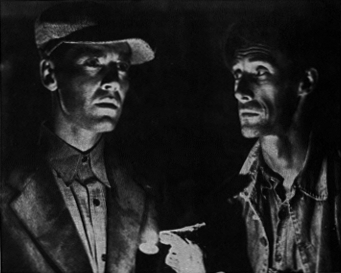
Joad lấy miếng thịt nướng cuối cùng còn xâu vào dây kẽm, tay anh đưa mời quanh. Không ai ăn, anh ngồi lại , nhai chậm hơn. Miệng nhai đều đều, anh đưa ống tay áo chùi quanh lớp mỡ dính quanh miệng. Đôi mắt tối thẩm, lờ đờ, hơi khép, anh nghiền ngẫm nhìn vào đống lửa đang cháy yếu dần.
-Ai cũng về miền tây hết sao? khi ra tù cháu phải làm bản cam kết (parole) hứa với họ là không được rời bang này mà .
-Cháu được làm bản cam kết ư? Muley ngạc nhiên … ta có nghe chuyện này, có làm bản cam kết như thế có nghĩa làm sao vậy cháu?
-Ồ, cháu được tha sớm trước thời hạn ba năm. Cháu phải có làm bản cam kết thuờng xuyên báo cáo với họ, còn không họ bắt cháu lại vào tù .
-Nhà tù McAlester đối xử với tù có tốt không? nghe bên cánh vợ ta nói, có người em họ từng ở tù tại McAlester quá khổ.

-Không tệ lắm chú à, Joad thật thà trả lời Muley.
-Cũng giống nhà tù khác, họ gắt gao với bác nếu bác làm loạn. Nếu biết sống hòa với họ thì được tử tế. Đừng để cai tù phải vào trừng trị bác. Con biết nghe lời nên yên. Con biết tìm công việc gì đó trong tù, như người khác từng làm. Con học viết tuy không ra gì. Chẳng có giá trị , chữ không ra chữ.(nguyên: Birds and stuff) Ông già cháu chắc sẽ nhức mắt khi cháu viết. Và Pa sẽ nỗi điên mất . Ba cháu chẳng ưa kiểu viết ‘nghiêng bên này đá bên kia’ (nguyên văn: no fancy stuff) vậy đâu. Ba cháu cũng chẳng ưa cách viết nghiêm túc trong sách vở, cháu đoán ông rất sợ. Có những lúc Pa viết gì đó và người ta cầm đi mất.
-Nhà tù có bao giờ đánh đập cháu hay hành hạ gì không ?
-Chưa, nhờ cháu chăm chú làm những gì cháu thích. Dĩ nhiên, bác thấy đó khi mê công việc gì thì chết mệt theo đó. Ngày này qua ngày khác hết bốn năm trời. Nếu hổ thẹn khi làm không xong, thì cứ mãi nghĩ về chuyện đó. Mà khốn thật, cháu cứ nằm thấy thằng Herb Turnbull cầm dao tới cháu, rồi cháu lại dùng xẽng đánh nó gục xuống.
Muley giải thích:
-Ai cũng bị như thế cả.
Thầy đạo nảy giờ ngồi nhìn chăm chặp vào đống lửa. Vầng trán cao, trắng lên giữa bóng tối đang chiếm ngự xung quanh. Vài tia lửa nho nhỏ còn sót lại còn làm rõ đường gân cổ. Tay ông liên tục xoa bóp khớp xương hai đầu gối.
Joad liệng khúc xương cuối cùng vào đống than, liếm đầu ngón tay xong anh chùi vào ống quần. Anh đứng dậy, bước tới hàng hiên lấy lại chai nước, anh uống dè xẻn một ít xong chuyền cho người khác trước khi ngồi lại.
Anh tiếp tục:
-Cháu rước họa vào thân khi làm một điều vô nghĩa. Đừng ai tìm kiếm những điều vô nghĩa khi cố chống lại những thứ mình không chống nổi. Đời là vậy. Khi người ta bắt ai vào tù giam đến bốn năm, thì cũng có ý nghĩa nào đó. Con người lúc đó mới có cơ hội suy nghĩ những việc mình làm. Cháu ví dụ, họ giam cháu lại và nuôi ăn tới bốn năm. Chuyện này làm cháu suy nghĩ không dám tái phạm nữa hay sợ bị trừng phạt mà tránh vào tù lại...
Joad ngừng một lát…nhưng nếu thằng Herb hay bất cứ ai làm hại cháu một lần nữa, thì cháu phải phản ứng như thế thôi.
-Cháu có thể phạm tội trước lúc nhận ra, nhất là những lúc say rượu, sự vô tri mà thằng đàn ông nào cũng phạm phải.
Muley phân tích có vẻ thông hiểu tin tức nhiều:
-Quan tòa phán cháu với tội danh nhẹ vì đó hoàn toàn không phải lỗi một mình cháu tạo nên.
-Quan tòa phán cháu với tội danh nhẹ vì đó hoàn toàn không phải lỗi một mình cháu tạo nên.
Joad tiếp:
- Có gã tù chung thân trong nhà tù- anh ta là thư ký của ông hiệu trưởng nào đó. Anh năng viết thư về cho ông ấy. Ồ, anh ấy nổi bật nhất trong đám tù nhờ đọc nhiều về luật. Có lần cháu hỏi chuyện với anh ta về nhà tù vì biết anh ta đọc nhiều. Anh nói, đừng đọc nhiều không tốt. Mọi sách trong tù giờ khác xưa. Đọc những loại ấy thời này chỉ giúp người ta mau trở lại tù thôi, và xem chừng ít ai có khả năng giảm được tình trạng tù tội. Anh ấy nói Cầu xin Chúa, đừng đọc thêm nữa, chỉ làm đầu óc ta tệ thêm, càng làm chúng ta hết tôn trọng những nhân viên của chính quyền thôi.
- Có gã tù chung thân trong nhà tù- anh ta là thư ký của ông hiệu trưởng nào đó. Anh năng viết thư về cho ông ấy. Ồ, anh ấy nổi bật nhất trong đám tù nhờ đọc nhiều về luật. Có lần cháu hỏi chuyện với anh ta về nhà tù vì biết anh ta đọc nhiều. Anh nói, đừng đọc nhiều không tốt. Mọi sách trong tù giờ khác xưa. Đọc những loại ấy thời này chỉ giúp người ta mau trở lại tù thôi, và xem chừng ít ai có khả năng giảm được tình trạng tù tội. Anh ấy nói Cầu xin Chúa, đừng đọc thêm nữa, chỉ làm đầu óc ta tệ thêm, càng làm chúng ta hết tôn trọng những nhân viên của chính quyền thôi.
- Giờ thì ta đếch cần tôn trọng gì bọn chúng, Muley quả quyết… thứ chính quyền cứ dựa vào chúng ta để đục khoét và kiếm lợi nhuận. Có điều, ta giờ đang bối rối là thằng lái chiếc máy cày, hắn là Willy Feeley, đang chỉ huy toán người làm trên cánh đồng này. Chuyện này ta có phần lo. Người tới từ nơi khác thì không hiểu, chứ thằng Willy thì trong bà con ở đây ra tức nhiên nó hiểu. Ta tới hỏi vào mặt nó. Nó giận dữ trả lời rằng 'tôi có hai đứa nhỏ, vợ tôi và mẹ vợ, họ cần có cái ăn' . Hắn càng cáu tiết hơn nói thêm 'Tôi đếch biết gì hết, ngoài thứ duy nhất tôi phải lo cho người nhà của tôi thôi' Nó có vẻ hổ thẹn khi cố bào chữa rằng 'chuyện những người khác đó là việc của trên lo '.
Thầy Jim Casy lúc nào giờ lặng nhìn ánh lửa tàn dần, mắt ông mở lớn , bắp gân ở cổ như rướn cao hơn. Cuối cùng ông kêu lên:
-Ta hiểu rồi, chỉ có cách là người ta phải có đủ linh hồn, ta hiểu rồi, thật là bất ngờ.
Thầy đạo nói đên đây chồm lên, bật lên ngồi xuống, đầu ông lắc lư mãi.
-Khi ta có cái lều, hàng đêm ta còn nhóm được đến năm trăm giáo hữu. Hai người chắc đã thấy ta.
Ông ngưng nói nhìn vào hai người,
-các người còn nhớ ta chẳng quyên đồng nào khi tới giảng cho bà con không? tất cả tập trung trong cái vựa này còn tràn cả bên ngoài.
-Vâng nhờ Chúa, thầy không quyên xu nào, Muley xác nhận.
-Bà con đây thật điên khi chẳng tặng cho thầy đồng nào, trong khi các vị khác tới đây, lúc chìa mũ ra thì họ lại 'Thưa ngài Đây ạ'.
Casy tiếp lời Muley
-Ta cũng cần ăn, ta cũng cần quần dài để mặc khi ra ngoài, đôi giày cũ khi phải cuốc bộ trên mặt đất, nhưng khi có cái lều thì chẳng còn vậy nữa. Có ngày ta có được mười hay hai mươi đô la. Việc đó chẳng gì hạnh phúc, do đó ta bỏ việc tiền nong đi và ta thấy hạnh phúc. Ta cho rằng ta đã nghĩ ra. Ta không biết điều đó là gì để nói cho đúng. Ta đoán chừng cũng đừng nên gắng. Nhưng có một nơi thích hợp cho người thầy giảng đạo như ta, nơi đó thích hợp cho công việc này để ta tái tục giảng đạo. Đó! bà con đang lưu lạc ngoài đường, không đất , không nhà, không nơi chốn nào để tới. Bà con cần phải có thứ gì làm nơi trú thân . Có thể...

Ông đứng lên bên ngọn lửa. Trăm thớ thịt trên cần cổ của thầy đạo nhô cao, ánh lửa cùng ánh than hồng lấp lóe như chìm sâu vào mắt ông. Người thầy nhìn trân trân vào ngọn lửa, nét mặt căng thẳng như đang lắng nghe điều gì, hai bàn tay như sẵn sàng giữ, giải quyết, hay liệng đi những ý tưởng nào đó, rồi im, xong nhanh. Ông xỏ tay vào túi quần. Vài con dơi bay qua, liệng lại, vỗ cánh loang choạng trên đống lửa đang lịm dần. Ngoài cánh đồng vọng lại tiếng chim ưng kêu đêm, nho nhỏ rời rạc, như tiếng bong bóng nước.
Tom lặng đưa tay vào túi quần lấy ra gói thuốc, anh chậm rãi vừa vấn điếu thuốc vừa nhìn vào đống than. Anh chẳng nghe trọn vẹn lời nói của người thầy đạo, y như chuyện riêng của ông nên anh chẳng cần để ý. Anh buộc miệng:
-Đêm này qua đêm khác, nằm trên cái giường tầng con hình dung hình ảnh nhà con ngày ra tù. Con tưởng tượng, Ông Bà lúc đó mất rồi, ba má con có thêm vài đứa con. Có thể Pa không còn khó tánh nữa, và Má có thể ở nhà để chị Rosasharn làm việc thay. Con nghĩ khi về sẽ khác xa nhiều... Thôi, con đoán chúng ta phải nghỉ lại đây đêm nay ngày mai sẽ đi tìm nhà chú John. Đó là việc ít nhất con phải làm, thầy có muốn tới đó không?
Thầy đạo vẫn đứng nhìn đống than. Ông chậm chạp trả lời,
-Vâng, ta sẽ đi cùng con. Và khi gia đình con chính thức bước chân ra đường, ta cũng bước theo. Khi tất cả bắt đầu lên đường ta sẽ đi theo.
-Gia đình con rất hân hạnh, Joad nói.
-Má con luôn ủng hộ thầy. Má từng nói thầy là người thầy đạo rất đáng tín cẩn. Chị Rorasharn thì chưa được khôn lớn.
Anh quay đầu lại,
-Chú Muley, chú có đi cùng cháu không?
Muley đang quay đầu hướng về phía con đường đưa họ tới đây.
-Hãy suy nghĩ mà đi chú Muley? Joad lập lại.
-Hãy suy nghĩ mà đi chú Muley? Joad lập lại.

-Hả ? không đâu. Ta không đi đâu cả, ta không rời chốn này. Xem kìa có vệt sáng đằng kia kìa, nó cứ nhấp nhô lên xuống ? Có thể người quản lý vùng bông này đang tới. Không chừng họ sẽ thấy ánh lửa chúng ta cũng nên?
Tom nhìn ra. Ánh sáng đó đi gần qua ngọn đồi.
-Chúng ta không làm gì hại họ, anh nói… chúng ta trú tại đây, chúng ta không làm gì hết.
Muley khẩn khoản:
-Đúng, chúng ta không làm gì, nhưng chúng ta xâm phạm (trespassing)vào đất đai họ. Do vậy chúng ta không thể ở lại đây. Hai tháng nay họ đang truy lùng ta. Giờ, mấy người nhìn kìa nếu chiếc xe kia trờ tới, chúng ta hãy vụt ra đám bông mà nằm xuống ngay. Không cần phải chạy quá xa. Xin Chúa bắt chúng tìm nhưng chẳng thấy chúng ta. Nhớ! cúi thấp đầu xuống.
Joad yêu cầu:
-Chú Muley sao thế? Chú là người không bao giờ biết chạy trốn mà? Chú nhiều thủ đoạn thật.
Muley chăm chú nhìn ánh đèn xe đang tiến gần:
-Đúng, ta là người đầy thủ đoạn chẳng khác chi con sói. Giờ ta lại thủ đoạn như con chồn. Khi cháu đi săn, cháu là người thợ săn, mạnh khỏe, không ai thắng nổi một thợ săn cả. Nhưng khi cháu BỊ SĂN thì hoàn cảnh lại khác. Cháu sẽ biến đổi hoàn toàn, không còn mạnh mẽ nữa. Cháu trở thành hung dữ, dù không còn chút sức lực nào. Ta bị săn lùng bao lâu nay rồi. Ta không còn là người đi săn nữa. Trong bóng tối ta có thể bắn được một thằng, nhưng ta không vồ được ai khi đã có hàng rào che chở. Ta không lừa gạt các người và ta nói ra đó là sự thật.
Đó là sự thật. -Thế thì chú ra ngoài mà núp mau lên-Joad hối.
-Chú hãy để cháu và thầy Casy trong này nói với mấy thằng chó này đôi điều.
Tia đèn chiếu càng gần lại, thỉnh thoảng nó hắt lên bầu trời rồi lại biến đi, tiếp tục hắt lên lần khác. Ba người đều chăm chú nhìn.
Muley giải thích tiếp…
-khi bị săn lung, thì có thêm một điều đáng nói, đó là lúc cháu nghĩ tới nhièu chuyện nguy ngập, rủi ro. Lúc cháu đi lùng người khác thì sao? Cháu không cần lo nghĩ gì và chẳng sợ ai cả. Như cháu vừa mách với ta nếu cháu làm chuyện rắc rối thì chúng sẽ đem cháu lại nhà tù McAlester ở cho đến khi mãn hạn.

-Chú nói nghe có lý , Joad đồng ý…đó là những gì người ta báo trước với cháu. Nhưng chỉ nằm ở đây qua đêm, chẳng phá hoại ai, không làm điều gì phạm luật. Đâu có giống say rượu và phá phách hả chú?
Muley cười phá lên:
-Đó cháu thấy đó, cháu nằm đây ư? và chiếc xe kia tới. Có thể là thằng Willy Feely không chừng. Mà Willy giờ đã là phó cảnh sát trưởng vùng này. Willy sẽ hỏi 'tại sao các anh xâm phạm đất này?' Ồ, cháu phải luôn biết cho rằng Willy là thằng đầy chuyện tào lao, và lúc này cháu hỏi nó 'đây là gì của mày?' Câu hỏi này làm hắn điên tiết rồi hắn sẽ nói 'ông liệu mà đi không thì tôi bắt ông đó' và cháu đương nhiên là lo tránh thằng Feeley do lúc đó hắn thật đáng sợ. Hắn vẫn cúi đầu làm một cách vô tội vạ và cháu khó lòng chống hắn. Ôi, thật khốn nạn, nằm vạ giữa vạt bông thì dễ lắm, nhưng chỉ tổ làm trò cười cho chúng. Làm chúng càng điên lên và cháu không thể làm gì, chỉ tổ làm trò hề cho tụi nó. Nếu cháu tìm cách nói chuyện với Willy hay tên chủ nào khác hay cháu đánh nó ư? Thì đó là cơ hội cho tụi nó bắt cháu, xong đưa cháu lại nhà tù McAlester thêm ba năm nữa, cháu biết không?
Joad gật gù:
-Chú nói nghe hữu lý, lời nào chú nói ra đều có ý nghĩa cả. Nhưng, có đức Giêsu, cháu rất ghét bị áp bức! Cháu thà là đánh vào mặt thằng Willy cho hả tức còn hơn.
-Chú nói nghe hữu lý, lời nào chú nói ra đều có ý nghĩa cả. Nhưng, có đức Giêsu, cháu rất ghét bị áp bức! Cháu thà là đánh vào mặt thằng Willy cho hả tức còn hơn.
-Nó có súng đó!
Muley phân bua...nó làm phó nên nó có quyền dùng súng. Một là nó phải giết cháu hai là cháu phải cướp cho được súng mà giết nó. Tommy nói cho rõ xem nào, một là thấy cháu là một đứa ngu ngơ nằm liều mạng ra mà thách với lũ chúng, hai là cháu làm sao chứng tỏ cháu là đứa bản lãnh, đáng gờm hơn mới được.

Ánh đèn giờ lại chiếu lên bầu trời, tiếng máy xe nổ đều nghe rất rõ.
-Lẹ lên Tommy ! nhưng đừng chạy xa, chỉ mười bốn mười lăm luống bông là đủ rồi, chúng ta còn thấy được chúng làm gì ở đây.
Tom đứng phắc dậy,
-Lạy Chúa, chú nói đúng. Trên đời này cháu chưa thắng được ai, tụi nó là gì cũng chẳng sợ đâu.
-Mau lên, lối này màu lên, Muley hối xong vòng quanh nhà rồi lẩn vào đám bông khoảng năm chục thuớc (yard)
-Đây được rồi, nằm xuống hai người cúi sát đầu nếu đèn pin quét tới, cảnh này coi bộ vui.

Cả ba nằm sấp, ép sát người trên mặt đất, dựa sức nặng lên trên hai khuỷu tay. Muley vọt lên chạy vào nhà, trong vài giây ông ta trở lại vứt đống áo và hai chiếc giày xuống đất.
-phải mang những thứ này ra, đến lúc trả thù rồi, Muley lẩm bẩm.
Ánh đèn chiếu lên trên nóc xong chiếu xuống bên dưới căn nhà.
Joad hỏi:
-Không biết tụi họ có cầm đèn pin ra đây tìm không? Ước gì lúc này cháu có cây gậy .
Joad hỏi:
-Không biết tụi họ có cầm đèn pin ra đây tìm không? Ước gì lúc này cháu có cây gậy .
Muley cười khúc khích:
-Không đâu, tụi nó không dám ra đâu. Ta đã nói với cháu, ta ranh ma như con chồn rừng (weasel). Willy làm thế, có đêm ta núp đằng sau và đã dùng cái cọc rào đánh y đánh y một cú như trời giáng (colder'n a wedge), thế là sau này khi nào hắn cũng mang theo năm người bảo vệ.
-Không đâu, tụi nó không dám ra đâu. Ta đã nói với cháu, ta ranh ma như con chồn rừng (weasel). Willy làm thế, có đêm ta núp đằng sau và đã dùng cái cọc rào đánh y đánh y một cú như trời giáng (colder'n a wedge), thế là sau này khi nào hắn cũng mang theo năm người bảo vệ.
Chiếc xe tiến lại căn nhà , ngọn đèn đứng yên.
-Cúi đầu xuống !!!
Muley kêu lên.
Ánh đèn sáng trắng, lạnh lẽo quét qua đầu ba người và quét chéo lên cánh đồng. Ba người đang cúi núp nên không thể thấy được hành động nào phía họ ngoài tiếng cửa xe đóng sầm lại và tiếng nói:
-Scairt lấy đèn đây!
Muley thì thầm:
-Một phát, hai phát, ta bắn vào ngọn đèn xe làm Willy cẩn thận. Do vậy hôm nay, hắn phải mang theo một người.
Có tiếng chân lạo xạo trên sàn rồi có ánh đèn pin chiếu ra từ trong ngôi nhà.
-Ta bắn vào trong nhà được không? Muley nói thật khẽ...nó sẽ không thấy phía bắn từ đâu tới . Phải cho nó cái gì để mà nhớ mới được.
-Được thôi, làm đi chú. Joad đồng ý ngay.
-Đừng làm thế , Casy can nho nhỏ
-Làm thế không hay đâu, chỉ vô ích thôi. Hãy suy nghĩ thật kỹ khi làm gì, làm thì phải có lợi mới được.
Lại có tiếng sột soạt gần căn nhà.
-Thôi khỏi bắn, Muley lại nói thầm… thôi dẹp đi.
Tiếng cửa xe đóng sầm lại, ánh ngọn đèn pha quét quanh và chiếc xe hướng ra đường trở lại.
-Cúi đầu xuống! Muley nói nhanh.
Họ đồng loạt cúi thấp đầu lại, ngọn đèn pha quét qua họ, chiếu qua và chiếu lại qua cánh đồng bông, chiếc xe bỏ đi xa hơn leo lên cao sau cùng biến mất.
Muley ngồi dậy,
-Willy, cuối cùng hắn luôn bấm đèn pin để tìm. Nó hay làm vậy do hắn cho vậy là khôn ngoan.
Casy nghi ngại:
-Có thể hắn cho vài người phục ở trong nhà, chờ chúng ta vô đó sẽ tóm hết không chừng.
-Có thể lắm, hai người đợi đây, ta biết quá trò này mà.
Nói xong, một người im lặng bước ra. Chỉ nghe tiếng lạo xạo thật khẽ theo hướng đi người đó. Hai người còn lại gắng nghe động tĩnh của người thứ nhất, cho đến khi tiếng chân vào đến trong kia.
Một thoáng sau có tiếng gọi từ trong nhà:
-Tụi nó không có núp lại đâu, vào đi!
Thầy Casy và Joad giờ mới vụt dậy, bước vào cái khoảng tối to lớn căn nhà. Muley gặp hai người gần đống tro vẫn còn bốc khói.
-Ta không nghĩ tụi nó dám để ai lại đây, Muley nói có vẻ tự hào…Willy bị ta đánh gục một lần, một phát, hai phát ta bắn tan hai đèn trước xe nó nên tụi nó cẩn thận vô cùng. Tụi nó không bao giờ chắc chắn ta ở đâu, và không khi nào tóm được ta. Ta chẳng hề ngủ gần ngôi nhà nào. Nếu hai người dám đi theo ta, ta sẽ chỉ chỗ ngủ, ở đó chẳng có thằng nào tóm được ai đâu.
-Chú dẫn đường đi, chúng tôi theo chú. Cháu không cho là trú ẩn an toàn trong nhà cha cháu ở đây đâu, Joad thúc Muley.
Muley tiến ra cánh đồng, Joad và thầy Casy bước theo. Họ vừa đi, chân đá mấy cây bông đang mọc:
-Nhờ mấy cây này mà chúng ta núp được kín đáo đây , Mulley thật lòng.
Họ đi theo một hàng dọc giữa cánh đồng. Ngang mương nước cũ họ trượt xuống lòng mương dễ dàng.
-Tạ ơn Chúa, cháu đoan chắc và cá với hai người , Joad la lên… có phải đây là cái hang tại bờ sông không ?
-Đúng đó, sao cháu biết?
-Chính cháu đào hang này. Cháu và anh Noah đào nó. Lúc đó tụi cháu nói là đào vàng nhưng làm thì như con nít đào hang chơi vậy.
Cái thành mương giờ cao hơn đầu ba người.
-Gần tới rồi, Joad tin tưởng.
- cháu nhớ, rất gần tới hang đó rồi.
Muley thố lộ
-Ta luôn ngụy trang hang này, không ai thấy được đâu.
Nền hang đào vàng giờ đã đến, nền toàn cát.
Joad ngồi nghỉ trên nền cát sạch.
Joad ngồi nghỉ trên nền cát sạch.
-Không có cái hang này chắc không ngủ được, cháu ngủ chỗ này chắc yên, nói xong Joad cuộn cái áo làm gối, đặt dưới đầu.
Mulley kéo tấm chắn ngụy trang lại xong vào phần hang của mình.
-Ta cũng ưa nơi này, ông ta nói vọng qua… ta cảm thấy khó ai tìm ra ta được.
Jim Casy vẫn ngồi yên trên cát, gần bên Joad.
Joad thì thào
-Thầy gắng ngủ một chút đi thầy, rạng sáng chúng ta phải di tới nhà Bác John của cháu ngay.
-Ta không ngủ được, thầy Casy trả lời, …trong đầu ta giờ lắm điều suy nghĩ,
Bàn chân ông dãn ra, hai chân khép sát vào nhau. Đầu vị thầy ngữa lên trời, ông ngắm mấy vì sao lấp lánh trên cao. Joad ngáp dài, đặt bàn tay dưới đầu. Hai người im lặng.
Bàn chân ông dãn ra, hai chân khép sát vào nhau. Đầu vị thầy ngữa lên trời, ông ngắm mấy vì sao lấp lánh trên cao. Joad ngáp dài, đặt bàn tay dưới đầu. Hai người im lặng.

Cuộc sống thế gới về đêm giờ đây bắt đầu xuất hiện trên mặt đất. Những cái lỗ, hang, bụi rậm bắt đầu nhúc nhích cảnh sinh hoạt của muôn thú. Những con chuột đồng (gopher) bắt đầu di chuyển, mấy chú thỏ đang mò ra kiếm lá, loài chuột nhỏ chạy thoăn thoắt vụt qua những hòn đất, và những con chim săn đêm im lìm bay trên đầu chúng. /.
HẾT CHAPTER 6
ĐHL dịch và edit July 8, 2025

[1]:
Mối thù truyền kiếp giữa hai dòng họ Hatfield và McCoy khoảng 1863 -1891
xảy ra tại giáp ranh West Virginia và Kentucky, theo vùng Tug Fork và sông Big Sandy. Dòng họ Hatfield ờ West virginia của William Anderson trong khi dòng McCoys ở Kentucky dưới sự cai quản của Randolph "Ole Ran;l" McCoy. Sự thù hận tính từ Epharaim Hatfield sinh năm 1765 và William McCoy sinh năm 1750. Mối thù truyền kiếp được dùng trong văn chương Mỹ ám chỉ cho đối thủ cay đằng và đáng gờm dai dẳng nào đó sau này.
==================
ENGLISH
THE REVEREND CASY and young Tom stood on the hill and looked down on the
Joad place. The small unpainted house was mashed at one corner, and it had been
pushed off its foundations so that it slumped at an angle, its blind front windows
pointing at a spot of sky well above the horizon. The fences were gone and the cotton
grew in the dooryard and up against the house, and the cotton was about the shed barn.
The outhouse lay on its side, and the cotton grew close against it. Where the dooryard
had been pounded hard by the bare feet of children and by stamping horses' hooves and
by the broad wagon wheels, it was cultivated now, and the dark green, dusty cotton
grew. Young Tom stared for a long time at the ragged willow beside the dry horse
trough, at the concrete base where the pump had been. "Jesus!" he said at last. "Hell
musta popped here. There ain't nobody livin' there." At last he moved quickly down the
hill, and Casy followed him. He looked into the barn shed, deserted, a little ground
straw on the floor, and at the mule stall in the corner. And as he looked in, there was a
skittering on the floor and a family of mice faded in under the straw. Joad paused at the
entrance to the tool-shed leanto, and no tools were there—a broken plow point, a mess
of hay wire in the corner, an iron wheel from a hayrake and a rat-gnawed mule collar, a
flat gallon oil can crusted with dirt and oil, and a pair of torn overalls hanging on a
nail. "There ain't nothin' left," said Joad. "We had pretty nice tools. There ain't nothin'
left."
Casy said, "If I was still a preacher I'd say the arm of the Lord had struck. But now I
don't know what happened. I been away. I didn't hear nothin'." They walked toward the
concrete well-cap, walked through cotton plants to get to it, and the bolls were forming
on the cotton, and the land was cultivated.
"We never planted here," Joad said. "We always kept this clear. Why, you can't get
a horse in now without he tromps the cotton." They paused at the dry watering trough,
and the proper weeds that should grow under a trough were gone and the old thick
wood of the trough was dry and cracked. On the well-cap the bolts that had held the
pump stuck up, their threads rusty and the nuts gone. Joad looked into the tube of the
well and listened. He dropped a clod down the well and listened. "She was a good
well," he said. "I can't hear water." He seemed reluctant to go to the house. He dropped
clod after clod down the well. "Maybe they're all dead," he said. "But somebody'd a
told me. I'd a got word some way."
"Maybe they left a letter or something to tell in the house. Would they of knowed
you was comin' out?"
"I don' know," said Joad. "No, I guess not. I didn't know myself till a week ago."
"Le's look in the house. She's all pushed out a shape. Something knocked the hell
out of her." They walked slowly toward the sagging house. Two of the supports of the
porch roof were pushed out so that the roof flopped down on one end. And the housecorner was crushed in. Through a maze of splintered wood the room at the corner was
visible. The front door hung open inward, and a low strong gate across the front door
hung outward on leather hinges.
Joad stopped at the step, a twelve-by-twelve timber. "Doorstep's here," he said. "But
they're gone—or Ma's dead." He pointed to the low gate across the front door. "If Ma
was anywheres about, that gate'd be shut an' hooked. That's one thing she always
done—seen that gate was shut." His eyes were warm. "Ever since the pig got in over to
Jacobs' an' et the baby. Milly Jacobs was jus' out in the barn. She come in while the pig
was still eatin' it. Well, Milly Jacobs was in a family way, an' she went ravin'. Never
did get over it. Touched ever since. But Ma took a lesson from it. She never lef' that
pig gate open 'less she was in the house herself. Never did forget. No—they're gone—
or dead." He climbed to the split porch and looked into the kitchen. The windows were
broken out, and throwing rocks lay on the floor, and the floor and walls sagged steeply
away from the door, and the sifted dust was on the boards. Joad pointed to the broken
glass and the rocks. "Kids," he said. "They'll go twenty miles to bust a window. I done
it myself. They know when a house is empty, they know. That's the fust thing kids do
when folks move out." The kitchen was empty of furniture, stove gone and the round
stovepipe hole in the wall showing light. On the sink shelf lay an old beer opener and a
broken fork with its wooden handle gone. Joad slipped cautiously into the room, and
the floor groaned under his weight. An old copy of the Philadelphia Ledger was on the
floor against the wall, its pages yellow and curling. Joad looked into the bedroom—no
bed, no chairs, nothing. On the wall a picture of an Indian girl in color, labeled Red
Wing. A bed slat leaning against the wall, and in one corner a woman's high button
shoe, curled up at the toe and broken over the instep. Joad picked it up and looked at it.
"I remember this," he said. "This was Ma's. It's all wore out now. Ma liked them shoes.
Had 'em for years. No, they've went—an' took ever'thing."
The sun had lowered until it came through the angled end windows now, and it
flashed on the edges of the broken glass. Joad turned at last and went out and crossed
the porch. He sat down on the edge of it and rested his bare feet on the twelve-bytwelve step. The evening light was on the fields, and the cotton plants threw long
shadows on the ground, and the molting willow tree threw a long shadow.
Casy sat down beside Joad. "They never wrote you nothin'?" he asked.
"No. Like I said, they wasn't people to write. Pa could write, but he wouldn't. Didn't
like to. It give him the shivers to write. He could work out a catalogue order as good as
the nex' fella, but he wouldn't write no letters just for ducks." They sat side by side,
staring off into the distance. Joad laid his rolled coat on the porch beside him. His
independent hands rolled a cigarette, smoothed it and lighted it, and he inhaled deeply
and blew the smoke out through his nose. "Somepin's wrong," he said. "I can't put my
finger on her. I got an itch that somepin's wronger'n hell. Just this house pushed aroun'
an' my folks gone."
Casy said, "Right over there the ditch was, where I done the baptizin'. You wasn't
mean, but you was tough. Hung onto that little girl's pigtail like a bulldog. We baptize'
you both in the name of the Holy Ghos', and still you hung on. Ol' Tom says, 'Hol' 'im
under water.' So I shove your head down till you start to bubblin' before you'd let go a
that pigtail. You wasn't mean, but you was tough. Sometimes a tough kid grows up
with a big jolt of the sperit in him."
A lean gray cat came sneaking out of the barn and crept through the cotton plants to
the end of the porch. It leaped silently up to the porch and crept low-belly toward the
men. It came to a place between and behind the two, and then it sat down, and its tail
stretched out straight and flat to the floor, and the last inch of it flicked. The cat sat and
looked off into the distance where the men were looking.
Joad glanced around at it. "By God! Look who's here. Somebody stayed." He put
out his hand, but the cat leaped away out of reach and sat down and licked the pads of
its lifted paw. Joad looked at it, and his face was puzzled. "I know what's the matter,"
he cried. "That cat jus' made me figger what's wrong."
"Seems to me there's lots wrong," said Casy.
"No, it's more'n jus' this place. Whyn't that cat jus' move in with some neighbors—
with the Rances. How come nobody ripped some lumber off this house? Ain't been
nobody here for three-four months, an' nobody's stole no lumber. Nice planks on the
barn shed, plenty good planks on the house, winda frames—an' nobody's took 'em.
That ain't right. That's what was botherin' me, an' I couldn't catch hold of her."
"Well, what's that figger out for you?" Casy reached down and slipped off his
sneakers and wriggled his long toes on the step.
"I don' know. Seems like maybe there ain't any neighbors. If there was, would all
them nice planks be here? Why, Jesus Christ! Albert Rance took his family, kids an'
dogs an' all, into Oklahoma City one Christmus. They was gonna visit with Albert's
cousin. Well, folks aroun' here thought Albert moved away without sayin' nothin'—
figgered maybe he got debts or some woman's squarin' off at him. When Albert come
back a week later there wasn't a thing lef' in his house—stove was gone, beds was
gone, winda frames was gone, an' eight feet of plankin' was gone off the south side of
the house so you could look right through her. He come drivin' home just as Muley
Graves was going away with the doors an' the well pump. Took Albert two weeks
drivin' aroun' the neighbors' 'fore he got his stuff back."
Casy scratched his toes luxuriously. "Didn't nobody give him an argument? All of
'em jus' give the stuff up?"
"Sure. They wasn't stealin' it. They thought he lef' it, an' they jus' took it. He got all
of it back—all but a sofa pilla, velvet with a pitcher of an Injun on it. Albert claimed
Grampa got it. Claimed Grampa got Injun blood, that's why he wants that pitcher.
Well, Grampa did get her, but he didn't give a damn about the pitcher on it. He jus'
liked her. Used to pack her aroun' an' he'd put her wherever he was gonna sit. He never
would give her back to Albert. Says, 'If Albert wants this pilla so bad, let him come an'
get her. But he better come shootin', 'cause I'll blow his goddamn stinkin' head off if he
comes messin' aroun' my pilla.' So finally Albert give up an' made Grampa a present of
that pilla. It give Grampa idears, though. He took to savin' chicken feathers. Says he's
gonna have a whole damn bed of feathers. But he never got no feather bed. One time
Pa got mad at a skunk under the house. Pa slapped that skunk with a two-by-four, and
Ma burned all Grampa's feathers so we could live in the house." He laughed.
"Grampa's a tough ol' bastard. Jus' set on that Injun pilla an' says, 'Let Albert come an'
get her. Why,' he says, 'I'll take that squirt and wring 'im out like a pair of drawers.'"
The cat crept close between the men again, and its tail lay flat and its whiskers
jerked now and then. The sun dropped low toward the horizon and the dusty air was
red and golden. The cat reached out a gray questioning paw and touched Joad's coat.
He looked around. "Hell, I forgot the turtle. I ain't gonna pack it all over hell." He
unwrapped the land turtle and pushed it under the house. But in a moment it was out,
headed southwest as it had been from the first. The cat leaped at it and struck at its
straining head and slashed at its moving feet. The old, hard, humorous head was pulled
in, and the thick tail slapped in under the shell, and when the cat grew tired of waiting
for it and walked off, the turtle headed on southwest again.
Young Tom Joad and the preacher watched the turtle go—waving its legs and
boosting its heavy, high-domed shell along toward the southwest. The cat crept along
behind for a while, but in a dozen yards it arched its back to a strong taut bow and
yawned, and came stealthily back toward the seated men.
"Where the hell you s'pose he's goin'?" said Joad. "I seen turtles all my life. They're
always goin' someplace. They always seem to want to get there." The gray cat seated
itself between and behind them again. It blinked slowly. The skin over its shoulders
jerked forward under a flea, and then slipped slowly back. The cat lifted a paw and
inspected it, flicked its claws out and in again experimentally, and licked its pads with
a shell-pink tongue. The red sun touched the horizon and spread out like a jellyfish,
and the sky above it seemed much brighter and more alive than it had been. Joad
unrolled his new yellow shoes from his coat, and he brushed his dusty feet with his
hand before he slipped them on.
The preacher, staring off across the fields, said, "Somebody's comin'. Look! Down
there, right through the cotton."
Joad looked where Casy's finger pointed. "Comin' afoot," he said. "Can't see 'im for
the dust he raises. Who the hell's comin' here?" They watched the figure approaching
in the evening light, and the dust it raised was reddened by the setting sun. "Man," said
Joad. The man drew closer, and as he walked past the barn, Joad said, "Why, I know
him. You know him—that's Muley Graves." And he called, "Hey, Muley! How ya?"
The approaching man stopped, startled by the call, and then he came on quickly. He
was a lean man, rather short. His movements were jerky and quick. He carried a gunny
sack in his hand. His blue jeans were pale at knee and seat, and he wore an old black
suit coat, stained and spotted, the sleeves torn loose from the shoulders in back, and
ragged holes worn through at the elbows. His black hat was as stained as his coat, and
the band, torn half free, flopped up and down as he walked. Muley's face was smooth
and unwrinkled, but it wore the truculent look of a bad child's, the mouth held tight and
small, the little eyes half scowling, half petulant.
"You remember Muley," Joad said softly to the preacher.
"Who's that?" the advancing man called. Joad did not answer. Muley came close,
very close, before he made out the faces. "Well, I'll be damned," he said. "It's Tommy
Joad. When'd you get out, Tommy?"
"Two days ago," said Joad. "Took a little time to hitchhike home. An' look here
what I find. Where's my folks, Muley? What's the house all smashed up for, an' cotton
planted in the dooryard?"
"By God, it's lucky I come by!" said Muley. "Cause ol' Tom worried himself. When
they was fixin' to move I was settin' in the kitchen there. I jus' tol' Tom I wan't gonna
move, by God. I tol' him that, an' Tom says, 'I'm worryin' myself about Tommy. S'pose
he comes home an' they ain't nobody here. What'll he think?' I says, 'Whyn't you write
down a letter?' An' Tom says, 'Maybe I will. I'll think about her. But if I don't, you
keep your eye out for Tommy if you're still aroun'.' 'I'll be aroun',' I says. 'I'll be aroun'
till hell freezes over. There ain't nobody can run a guy name of Graves outa this
country.' An' they ain't done it, neither."
Joad said impatiently, "Where's my folks? Tell about you standin' up to 'em later,
but where's my folks?"
"Well, they was gonna stick her out when the bank come to tractorin' off the place.
Your grampa stood out here with a rifle, an' he blowed the headlights off the cat', but
she come on just the same. Your grampa didn't wanta kill the guy drivin' that cat', an'
that was Willy Feeley, an' Willy knowed it, so he jus' come on, an' bumped the hell
outa the house, an' give her a shake like a dog shakes a rat. Well, it took somepin outa
Tom. Kinda got into 'im. He ain't been the same ever since."
"Where is my folks?" Joad spoke angrily.
"What I'm tellin' you. Took three trips with your Uncle John's wagon. Took the
stove an' the pump an' the beds. You should a seen them beds go out with all them kids
an' your granma an' grampa settin' up against the headboard, an' your brother Noah
settin' there smokin' a cigarette, an' spittin' la-de-da over the side of the wagon." Joad
opened his mouth to speak. "They're all at your Uncle John's," Muley said quickly.
"Oh! All at John's. Well, what they doin' there? Now stick to her for a second,
Muley. Jus' stick to her. In jus' a minute you can go on your own way. What they doin'
there?"
"Well, they been choppin' cotton, all of 'em, even the kids an' your grampa. Gettin'
money together so they can shove on west. Gonna buy a car and shove on west where
it's easy livin'. There ain't nothin' here. Fifty cents a clean acre for choppin' cotton, an'
folks beggin' for the chance to chop."
"An' they ain't gone yet?"
"No," said Muley. "Not that I know. Las' I heard was four days ago when I seen
your brother Noah out shootin' jackrabbits, an' he says they're aimin' to go in about two
weeks. John got his notice he got to get off. You jus' go on about eight miles to John's
place. You'll find your folks piled in John's house like gophers in a winter burrow."
"O.K.," said Joad. "Now you can ride on your own way. You ain't changed a bit,
Muley. If you want to tell about somepin off northwest, you point your nose straight
southeast."
Muley said truculently, "You ain't changed neither. You was a smart-aleck kid, an'
you're still a smart aleck. You ain't tellin' me how to skin my life, by any chancet?"
Joad grinned. "No, I ain't. If you wanta drive your head into a pile a broken glass,
there ain't nobody can tell you different. You know this here preacher, don't you,
Muley? Rev. Casy."
"Why, sure, sure. Didn't look over. Remember him well." Casy stood up and the
two shook hands. "Glad to see you again," said Muley. "You ain't been aroun' for a hell
of a long time."
"I been off a-askin' questions," said Casy. "What happened here? Why they kickin'
folks off the lan'?"
Muley's mouth snapped shut so tightly that a little parrot's beak in the middle of his
upper lip stuck down over his under lip. He scowled. "Them sons-a-bitches," he said.
"Them dirty sons-a-bitches. I tell ya, men, I'm stayin'. They ain't gettin' rid a me. If
they throw me off, I'll come back, an' if they figger I'll be quiet underground, why, I'll
take couple-three of the sons-a-bitches along for company." He patted a heavy weight
in his side coat pocket. "I ain't a-goin'. My pa come here fifty years ago. An' I ain't agoin'."
Joad said, "What's the idear of kickin' the folks off?"
"Oh! They talked pretty about it. You know what kinda years we been havin'. Dust
comin' up an' spoilin' ever'thing so a man didn't get enough crop to plug up an ant's ass.
An' ever'body got bills at the grocery. You know how it is. Well, the folks that owns
the lan' says, 'We can't afford to keep no tenants.' An' they says, 'The share a tenant
gets is jus' the margin a profit we can't afford to lose.' An' they says, 'If we put all our
lan' in one piece we can jus' hardly make her pay.' So they tractored all the tenants off a
the lan'. All 'cept me, an' by God I ain't goin'. Tommy, you know me. You knowed me
all your life."
"Damn right," said Joad, "all my life."
"Well, you know I ain't a fool. I know this land ain't much good. Never was much
good 'cept for grazin'. Never should a broke her up. An' now she's cottoned damn near
to death. If on'y they didn't tell me I got to get off, why, I'd prob'y be in California right
now a-eatin' grapes an' a-pickin' an orange when I wanted. But them sons-a-bitches
says I got to get off—an', Jesus Christ, a man can't, when he's tol' to!"
"Sure," said Joad. "I wonder Pa went so easy. I wonder Grampa didn' kill nobody.
Nobody never tol' Grampa where to put his feet. An' Ma ain't nobody you can push
aroun' neither. I seen her beat the hell out of a tin peddler with a live chicken one time
'cause he give her a argument. She had the chicken in one han', an' the ax in the other,
about to cut its head off. She aimed to go for that peddler with the ax, but she forgot
which hand was which, an' she takes after him with the chicken. Couldn' even eat that
chicken when she got done. They wasn't nothing but a pair a legs in her han'. Grampa
throwed his hip outa joint laughin'. How'd my folks go so easy?"
"Well, the guy that comes aroun' talked nice as pie. 'You got to get off. It ain't my
fault.' 'Well,' I says, 'whose fault is it? I'll go an' I'll nut the fella.' 'It's the Shawnee Lan'
an' Cattle Company. I jus' got orders.' 'Who's the Shawnee Lan' an' Cattle Company?'
'It ain't nobody. It's a company.' Got a fella crazy. There wasn't nobody you could lay
for. Lot a the folks jus' got tired out lookin' for somepin to be mad at—but not me. I'm
mad at all of it. I'm stayin'."
A large red drop of sun lingered on the horizon and then dripped over and was gone,
and the sky was brilliant over the spot where it had gone, and a torn cloud, like a
bloody rag, hung over the spot of its going. And dusk crept over the sky from the
eastern horizon, and darkness crept over the land from the east. The evening star
flashed and glittered in the dusk. The gray cat sneaked away toward the open barn shed
and passed inside like a shadow.
Joad said, "Well, we ain't gonna walk no eight miles to Uncle John's place tonight.
My dogs is burned up. How's it if we go to your place, Muley? That's on'y about a
mile."
"Won't do no good." Muley seemed embarrassed. "My wife an' the kids an' her
brother all took an' went to California. They wasn't nothin' to eat. They wasn't as mad
as me, so they went. They wasn't nothin' to eat here."
The preacher stirred nervously. "You should of went too. You shouldn't of broke up
the fambly."
"I couldn'," said Muley Graves. "Somepin jus' wouldn' let me."
"Well, by God, I'm hungry," said Joad. "Four solemn years I been eatin' right on the
minute. My guts is yellin' bloody murder. What you gonna eat, Muley? How you been
gettin' your dinner?"
Muley said ashamedly, "For a while I et frogs an' squirrels an' prairie dogs
sometimes. Had to do it. But now I got some wire nooses on the tracks in the dry
stream brush. Get rabbits, an' sometimes a prairie chicken. Skunks get caught, an'
coons, too." He reached down, picked up his sack, and emptied it on the porch. Two
cottontails and a jackrabbit fell out and rolled over limply, soft and furry.
"God Awmighty," said Joad, "it's more'n four years sence I've et fresh-killed meat."
Casy picked up one of the cottontails and held it in his hand. "You sharin' with us,
Muley Graves?" he asked.
Muley fidgeted in embarrassment. "I ain't got no choice in the matter." He stopped
on the ungracious sound of his words. "That ain't like I mean it. That ain't. I mean"—
he stumbled—"what I mean, if a fella's got somepin to eat an' another fella's hungry—
why, the first fella ain't got no choice. I mean, s'pose I pick up my rabbits an' go off
somewheres an' eat 'em. See?"
"I see," said Casy. "I can see that. Muley sees somepin there, Tom. Muley's got aholt of somepin, an' it's too big for him, an' it's too big for me."
Young Tom rubbed his hands together. "Who got a knife? Le's get at these here
miserable rodents. Le's get at 'em."
Muley reached in his pants pocket and produced a large horn-handled pocket knife.
Tom Joad took it from him, opened a blade, and smelled it. He drove the blade again
and again into the ground and smelled it again, wiped it on his trouser leg, and felt the
edge with his thumb.
Muley took a quart bottle of water out of his hip pocket and set it on the porch. "Go
easy on that there water," he said. "That's all there is. This here well's filled in."
Tom took up a rabbit in his hand. "One of you go get some bale wire outa the barn.
We'll make a fire with some a this broken plank from the house." He looked at the
dead rabbit. "There ain't nothin' so easy to get ready as a rabbit," he said. He lifted the
skin of the back, slit it, put his fingers in the hole, and tore the skin off. It slipped off
like a stocking, slipped off the body to the neck, and off the legs to the paws. Joad
picked up the knife again and cut off head and feet. He laid the skin down, slit the
rabbit along the ribs, shook out the intestines onto the skin, and then threw the mess off
into the cotton field. And the clean-muscled little body was ready. Joad cut off the legs
and cut the meaty back into two pieces. He was picking up the second rabbit when
Casy came back with a snarl of bale wire in his hand. "Now build up a fire and put
some stakes up," said Joad. "Jesus Christ, I'm hungry for these here creatures!" He
cleaned and cut the rest of the rabbits and strung them on the wire. Muley and Casy
tore splintered boards from the wrecked house-corner and started a fire, and they drove
a stake into the ground on each side to hold the wire.
Muley came back to Joad. "Look out for boils on that jackrabbit," he said. "I don't
like to eat no jackrabbit with boils." He took a little cloth bag from his pocket and put
it on the porch.
Joad said, "The jack was clean as a whistle—Jesus God, you got salt too? By any
chance you got some plates an' a tent in your pocket?" He poured salt in his hand and
sprinkled it over the pieces of rabbit strung on the wire.
The fire leaped and threw shadows on the house, and the dry wood crackled and
snapped. The sky was almost dark now and the stars were out sharply. The gray cat
came out of the barn shed and trotted miaowing toward the fire, but, nearly there, it
turned and went directly to one of the little piles of rabbit entrails on the ground. It
chewed and swallowed, and the entrails hung from its mouth.
Casy sat on the ground beside the fire, feeding it broken pieces of board, pushing
the long boards in as the flame ate off their ends. The evening bats flashed into the
firelight and out again. The cat crouched back and licked its lips and washed its face
and whiskers.
Joad held up his rabbit-laden wire between his two hands and walked to the fire.
"Here, take one end, Muley. Wrap your end around that stake. That's good, now! Let's
tighten her up. We ought to wait till the fire's burned down, but I can't wait." He made
the wire taut, then found a stick and slipped the pieces of meat along the wire until they
were over the fire. And the flames licked up around the meat and hardened and glazed
the surfaces. Joad sat down by the fire, but with his stick he moved and turned the
rabbit so that it would not become sealed to the wire. "This here is a party," he said.
"Salt, Muley's got, an' water an' rabbits. I wish he got a pot of hominy in his pocket.
That's all I wish."
Muley said over the fire, "You fellas'd think I'm touched, the way I live."
"Touched nothin'," said Joad. "If you're touched, I wisht ever'body was touched."
Muley continued, "Well, sir, it's a funny thing. Somepin went an' happened to me
when they tol' me I had to get off the place. Fust I was gonna go in an' kill a whole
flock a people. Then all my folks all went away out west. An' I got wanderin' aroun'.
Jus' walkin' aroun'. Never went far. Slep' where I was. I was gonna sleep here tonight.
That's why I come. I'd tell myself, 'I'm lookin' after things so when all the folks come
back it'll be all right.' But I knowed that wan't true. There ain't nothin' to look after.
The folks ain't never comin' back. I'm jus' wanderin' aroun' like a damn ol' graveyard
ghos'."
"Fella gets use' to a place, it's hard to go," said Casy. "Fella gets use' to a way a
thinkin' it's hard to leave. I ain't a preacher no more, but all the time I find I'm prayin',
not even thinkin' what I'm doin."
Joad turned the pieces of meat over on the wire. The juice was dripping now, and
every drop, as it fell in the fire, shot up a spurt of flame. The smooth surface of the
meat was crinkling up and turning a faint brown. "Smell her," said Joad. "Jesus, look
down an' just smell her!"
Muley went on, "Like a damn ol' graveyard ghos'. I been goin' aroun' the places
where stuff happened. Like there's a place over by our forty; in a gully they's a bush.
Fust time I ever laid with a girl was there. Me fourteen an' stampin' an' jerkin' an'
snortin' like a buck deer, randy as a billygoat. So I went there an' I laid down on the
groun', an' I seen it all happen again. An' there's the place down by the barn where Pa
got gored to death by a bull. An' his blood is right in that groun', right now. Mus' be.
Nobody never washed it out. An' I put my han' on that groun' where my own pa's blood
is part of it." He paused uneasily. "You fellas think I'm touched?"
Joad turned the meat, and his eyes were inward. Casy, feet drawn up, stared into the
fire. Fifteen feet back from the men the fed cat was sitting, the long gray tail wrapped
neatly around the front feet. A big owl shrieked as it went overhead, and the firelight
showed its white underside and the spread of its wings.
"No," said Casy. "You're lonely—but you ain't touched."
Muley's tight little face was rigid. "I put my han' right on the groun' where that
blood is still. An' I seen my pa with a hole through his ches', an' I felt him shiver up
against me like he done, an' I seen him kind of settle back an' reach with his han's an'
his feet. An' I seen his eyes all milky with hurt, an' then he was still an' his eyes so
clear—lookin' up. An' me a little kid settin' there, not cryin' nor nothin', jus' settin'
there." He shook his head sharply. Joad turned the meat over and over. "An' I went in
the room where Joe was born. Bed wasn't there, but it was the room. An' all them
things is true, an' they're right in the place they happened. Joe came to life right there.
He give a big ol' gasp an' then he let out a squawk you could hear a mile, an' his
granma standin' there says, 'That's a daisy, that's a daisy,' over an' over. An' her so
proud she bust three cups that night."
Joad cleared his throat. "Think we better eat her now."
"Let her get good an' done, good an' brown, awmost black," said Muley irritably. "I
wanta talk. I ain't talked to nobody. If I'm touched, I'm touched, an' that's the end of it.
Like a ol' graveyard ghos' goin' to neighbors' houses in the night. Peters', Jacobs',
Rance's, Joad's; an' the houses all dark, standin' like miser'ble ratty boxes, but they was
good parties an' dancin'. An' there was meetin's and shoutin' glory. They was weddin's,
all in them houses. An' then I'd want to go in town an' kill folks. 'Cause what'd they
take when they tractored the folks off the lan'? What'd they get so their 'margin a profit'
was safe? They got Pa dyin' on the groun', an' Joe yellin' his first breath, an' me jerkin'
like a billy goat under a bush in the night. What'd they get? God knows the lan' ain't no
good. Nobody been able to make a crop for years. But them sons-a-bitches at their
desks, they jus' chopped folks in two for their margin a profit. They jus' cut 'em in two.
Place where folks live is them folks. They ain't whole, out lonely on the road in a
piled-up car. They ain't alive no more. Them sons-a-bitches killed 'em." And he was
silent, his thin lips still moving, his chest still panting. He sat and looked down at his
hands in the firelight. "I—I ain't talked to nobody for a long time," he apologized
softly. "I been sneakin' aroun' like a ol' graveyard ghos'."
Casy pushed the long boards into the fire and the flames licked up around them and
leaped up toward the meat again. The house cracked loudly as the cooler night air
contracted the wood. Casy said quietly, "I gotta see them folks that's gone out on the
road. I got a feelin' I got to see them. They gonna need help no preachin' can give 'em.
Hope of heaven when their lives ain't lived? Holy Sperit when their own sperit is
downcast an' sad? They gonna need help. They got to live before they can afford to
die."
Joad cried nervously, "Jesus Christ, le's eat this meat 'fore it's smaller'n a cooked
mouse! Look at her. Smell her." He leaped to his feet and slid the pieces of meat along
the wire until they were clear of the fire. He took Muley's knife and sawed through a
piece of meat until it was free of the wire. "Here's for the preacher," he said.
"I tol' you I ain't no preacher."
"Well, here's for the man, then." He cut off another piece. "Here, Muley, if you ain't
too goddamn upset to eat. This here's jackrabbit. Tougher'n a bull-bitch." He sat back
and clamped his long teeth on the meat and tore out a great bite and chewed it. "Jesus
Christ! Hear her crunch!" And he tore out another bite ravenously.
Muley still sat regarding his meat. "Maybe I oughtn' to a-talked like that," he said.
"Fella should maybe keep stuff like that in his head."
Casy looked over, his mouth full of rabbit. He chewed, and his muscled throat
convulsed in swallowing. "Yes, you should talk," he said. "Sometimes a sad man can
talk the sadness right out through his mouth. Sometimes a killin' man can talk the
murder right out of his mouth an' not do no murder. You done right. Don't you kill
nobody if you can help it." And he bit out another hunk of rabbit. Joad tossed the bones
in the fire and jumped up and cut more off the wire. Muley was eating slowly now, and
his nervous little eyes went from one to the other of his companions. Joad ate scowling
like an animal, and a ring of grease formed around his mouth.
For a long time Muley looked at him, almost timidly. He put down the hand that
held the meat. "Tommy," he said.
Joad looked up and did not stop gnawing the meat. "Yeah?" he said, around a
mouthful.
"Tommy, you ain't mad with me talkin' about killin' people? You ain't huffy, Tom?"
"No," said Tom. "I ain't huffy. It's just somepin that happened."
"Ever'body knowed it was no fault of yours," said Muley. "Ol' man Turnbull said he
was gonna get you when ya come out. Says nobody can kill one a his boys. All the
folks hereabouts talked him outa it, though."
"We was drunk," Joad said softly. "Drunk at a dance. I don' know how she started.
An' then I felt that knife go in me, an' that sobered me up. Fust thing I see is Herb
comin' for me again with his knife. They was this here shovel leanin' against the
schoolhouse, so I grabbed it an' smacked 'im over the head. I never had nothing against
Herb. He was a nice fella. Come a-bullin' after my sister Rosasharn when he was a
little fella. No, I liked Herb."
"Well, ever'body tol' his pa that, an' finally cooled 'im down. Somebody says they's
Hatfield blood on his mother's side in ol' Turnbull, an' he's got to live up to it. I don't
know about that. Him an' his folks went on to California six months ago."
Joad took the last of the rabbit from the wire and passed it around. He settled back
and ate more slowly now, chewed evenly, and wiped the grease from his mouth with
his sleeve. And his eyes, dark and half closed, brooded as he looked into the dying fire.
"Ever'body's goin' west," he said. "I got me a parole to keep. Can't leave the state."
"Parole?" Muley asked. "I heard about them. How do they work?"
"Well, I got out early, three years early. They's stuff I gotta do, or they send me
back in. Got to report ever' so often."
"How they treat ya there in McAlester? My woman's cousin was in McAlester an'
they give him hell."
"It ain't so bad," said Joad. "Like ever'place else. They give ya hell if ya raise hell.
You get along O.K. les' some guard gets it in for ya. Then you catch plenty hell. I got
along O.K. Minded my own business, like any guy would. I learned to write nice as
hell. Birds an' stuff like that, too; not just word writin'. My ol' man'll be sore when he
sees me whip out a bird in one stroke. Pa's gonna be mad when he sees me do that. He
don't like no fancy stuff like that. He don't even like word writin'. Kinda scares 'im I
guess. Ever' time Pa seen writin', somebody took somepin away from 'im."
"They didn't give you no beatin's or nothin' like that?"
"No, I jus' tended my own affairs. 'Course you get goddamn good an' sick a-doin'
the same thing day after day for four years. If you done somepin you was ashamed of,
you might think about that. But, hell, if I seen Herb Turnbull comin' for me with a
knife right now, I'd squash him down with a shovel again."
"Anybody would," said Muley. The preacher stared into the fire, and his high
forehead was white in the settling dark. The flash of little flames picked out the cords
of his neck. His hands, clasped about his knees, were busy pulling knuckles.
Joad threw the last bones into the fire and licked his fingers and then wiped them on
his pants. He stood up and brought the bottle of water from the porch, took a sparing
drink, and passed the bottle before he sat down again. He went on. "The thing that give
me the mos' trouble was, it didn' make no sense. You don't look for no sense when
lightnin' kills a cow, or it comes up a flood. That's jus' the way things is. But when a
bunch of men take an' lock you up four years, it ought to have some meaning. Men is
supposed to think things out. Here they put me in, an' keep me an' feed me four years.
That ought to either make me so I won't do her again or else punish me so I'll be afraid
to do her again"—he paused—"but if Herb or anybody else come for me, I'd do her
again. Do her before I could figure her out. Specially if I was drunk. That sort of
senselessness kind a worries a man."
Muley observed, "Judge says he give you a light sentence 'cause it wasn't all your
fault."
Joad said, "They's a guy in McAlester—lifer. He studies all the time. He's sec'etary
of the warden—writes the warden's letters an' stuff like that. Well, he's one hell of a
bright guy an' reads law an' all stuff like that. Well, I talked to him one time about her,
'cause he reads so much stuff. An' he says it don't do no good to read books. Says he's
read ever'thing about prisons now, an' in the old times; an' he says she makes less sense
to him now than she did before he starts readin'. He says it's a thing that started way to
hell an' gone back, an' nobody seems to be able to stop her, an' nobody got sense
enough to change her. He says for God's sake don't read about her because he says for
one thing you'll jus' get messed up worse, an' for another you won't have no respect for
the guys that work the gover'ments."
"I ain't got a hell of a lot of respec' for 'em now," said Muley. "On'y kind a
gover'ment we got that leans on us fellas is the 'safe margin a profit.' There's one thing
that got me stumped, an' that's Willy Feeley—drivin' that cat', an' gonna be a straw
boss on lan' his own folks used to farm. That worries me. I can see how a fella might
come from some other place an' not know no better, but Willy belongs. Worried me so
I went up to 'im and ast 'im. Right off he got mad. 'I got two little kids,' he says. 'I got a
wife an' my wife's mother. Them people got to eat.' Gets madder'n hell. 'Fust an' on'y
thing I got to think about is my own folks,' he says. 'What happens to other folks is
their look-out,' he says. Seems like he's 'shamed, so he gets mad."
Jim Casy had been staring at the dying fire, and his eyes had grown wider and his
neck muscles stood higher. Suddenly he cried, "I got her! If ever a man got a dose of
the sperit, I got her. Got her all of a flash!" He jumped to his feet and paced back and
forth, his head swinging. "Had a tent one time. Drawed as much as five hundred people
ever' night. That's before either you fellas seen me." He stopped and faced them. "Ever
notice I never took no collections when I was preachin' out here to folks—in barns an'
in the open?"
"By God, you never," said Muley. "People around here got so use' to not givin' you
money they got to bein' a little mad when some other preacher came along an' passed
the hat. Yes, sir!"
"I took somepin to eat," said Casy. "I took a pair a pants when mine was wore out,
an' a ol' pair a shoes when I was walkin' through to the groun', but it wasn't like when I
had the tent. Some days there I'd take in ten or twenty dollars. Wasn't happy that-away, so I give her up, an' for a time I was happy. I think I got her now. I don't know if I
can say her. I guess I won't try to say her—but maybe there's a place for a preacher.
Maybe I can preach again. Folks out lonely on the road, folks with no lan', no home to
go to. They got to have some kind of home. Maybe—" He stood over the fire. The
hundred muscles of his neck stood out in high relief, and the firelight went deep into
his eyes and ignited red embers. He stood and looked at the fire, his face tense as
though he were listening, and the hands that had been active to pick, to handle, to
throw ideas, grew quiet, and in a moment crept into his pocket. The bats flittered in
and out of the dull firelight, and the soft watery burble of a night hawk came from
across the fields.
Tom reached quietly into his pocket and brought out his tobacco, and he rolled a
cigarette slowly and looked over it at the coals while he worked. He ignored the whole
speech of the preacher, as though it were some private thing that should not be
inspected. He said, "Night after night in my bunk I figgered how she'd be when I come
home again. I figgered maybe Grampa and Granma'd be dead, an' maybe there'd be
some new kids. Maybe Pa'd not be so tough. Maybe Ma'd set back a little an' let
Rosasharn do the work. I knowed it wouldn't be the same as it was. Well, we'll sleep
here, I guess, an' come daylight we'll get on to Uncle John's. Leastwise I will. You
think you're comin' along, Casy?"
The preacher still stood looking into the coals. He said slowly, "Yeah, I'm goin' with
you. An' when your folks start out on the road I'm goin' with them. An' where folks are
on the road, I'm gonna be with them."
"You're welcome," said Joad. "Ma always favored you. Said you was a preacher to
trust. Rosasharn wasn't growed up then." He turned his head. "Muley, you gonna walk
on over with us?" Muley was looking toward the road over which they had come.
"Think you'll come along, Muley?" Joad repeated.
"Huh? No. I don't go no place, an' I don't leave no place. See that glow over there,
jerkin' up an' down? That's prob'ly the super'ntendent of this stretch a cotton.
Somebody maybe seen our fire."
Tom looked. The glow of light was nearly over the hill. "We ain't doin' no harm,"
he said. "We'll jus' set here. We ain't doin' nothin'."
Muley cackled. "Yeah! We're doin' somepin jus' bein' here. We're trespassin'. We
can't stay. They been tryin' to catch me for two months. Now you look. If that's a car
comin' we go out in the cotton an' lay down. Don't have to go far. Then by God let 'em
try to fin' us! Have to look up an' down ever' row. Just keep your head down."
Joad demanded, "What's come over you, Muley? You wasn't never no run-an'-hide
fella. You was mean."
Muley watched the approaching lights. "Yeah!" he said. "I was mean like a wolf.
Now I'm mean like a weasel. When you're huntin' somepin you're a hunter, an' you're
strong. Can't nobody beat a hunter. But when you get hunted—that's different.
Somepin happens to you. You ain't strong; maybe you're fierce, but you ain't strong. I
been hunted now for a long time. I ain't a hunter no more. I'd maybe shoot a fella in the
dark, but I don't maul nobody with a fence stake no more. It don't do no good to fool
you or me. That's how it is."
"Well, you go out an' hide," said Joad. "Leave me an' Casy tell these bastards a few
things."
The beam of light was closer now, and it bounced into the sky and then disappeared,
and then bounced up again. All three men watched.
Muley said, "There's one more thing about bein' hunted. You get to thinkin' about
all the dangerous things. If you're huntin' you don't think about 'em, an' you ain't
scared. Like you says to me, if you get in any trouble they'll sen' you back to
McAlester to finish your time."
"That's right," said Joad. "That's what they tol' me, but settin' here restin' or sleepin'
on the groun'—that ain't gettin' in no trouble. That ain't doin' nothin' wrong. That ain't
like gettin' drunk or raisin' hell."
Muley laughed. "You'll see. You jus' set here, an' the car'll come. Maybe it's Willy
Feeley, an' Willy's a deputy sheriff now. 'What you doin' trespassin' here?' Willy says.
Well, you always did know Willy was full a crap, so you says, 'What's it to you?' Willy
gets mad an' says, 'You get off or I'll take you in.' An' you ain't gonna let no Feeley
push you aroun' 'cause he's mad an' scared. He's made a bluff an' he got to go on with
it, an' here's you gettin' tough an' you got to go through—oh, hell, it's a lot easier to lay
out in the cotton an' let 'em look. It's more fun, too, 'cause they're mad an' can't do
nothin', an' you're out there a-laughin' at 'em. But you jus' talk to Willy or any boss, an'
you slug hell out of 'em an' they'll take you in an' run you back to McAlester for three
years."
"You're talkin' sense," said Joad. "Ever' word you say is sense. But, Jesus, I hate to
get pushed around! I lots rather take a sock at Willy."
"He got a gun," said Muley. "He'll use it 'cause he's a deputy. Then he either got to
kill you or you got to get his gun away an' kill him. Come on, Tommy. You can easy
tell yourself you're foolin' them lyin' out like that. An' it all just amounts to what you
tell yourself." The strong lights angled up into the sky now, and the even drone of a
motor could be heard. "Come on, Tommy. Don't have to go far, jus' fourteen-fifteen
rows over, an' we can watch what they do."
Tom got to his feet. "By God, you're right!" he said. "I ain't got a thing in the worl'
to win, no matter how it comes out."
"Come on, then, over this way," Muley moved around the house and out into the
cotton field about fifty yards. "This is good," he said. "Now lay down. You on'y got to
pull your head down if they start the spotlight goin'. It's kinda fun." The three men
stretched out at full length and propped themselves on their elbows. Muley sprang up
and ran toward the house, and in a few moments he came back and threw a bundle of
coats and shoes down. "They'd of taken 'em along just to get even," he said. The lights
topped the rise and bore down on the house.
Joad asked, "Won't they come out here with flashlights an' look aroun' for us? I
wisht I had a stick."
Muley giggled. "No, they won't. I tol' you I'm mean like a weasel. Willy done that
one night an' I clipped 'im from behint with a fence stake. Knocked him colder'n a
wedge. He tol' later how five guys come at him."
The car drew up to the house and a spotlight snapped on. "Duck," said Muley. The
bar of cold white light swung over their heads and crisscrossed the field. The hiding
men could not see any movement, but they heard a car door slam and they heard
voices. "Scairt to get in the light," Muley whispered. "Once—twice I've took a shot at
the headlights. That keeps Willy careful. He got somebody with 'im tonight." They
heard footsteps on wood, and, then from inside the house they saw the glow of a
flashlight. "Shall I shoot through the house?" Muley whispered. "They couldn't see
where it come from. Give 'em somepin to think about."
"Sure, go ahead," said Joad.
"Don't do it," Casy whispered. "It won't do no good. Jus' a waste. We got to get
thinkin' about doin' stuff that means somepin."
A scratching sound came from near the house. "Puttin' out the fire," Muley
whispered. "Kickin' dust over it." The car doors slammed, the headlights swung around
and faced the road again. "Now duck!" said Muley. They dropped their heads and the
spotlight swept over them and crossed and recrossed the cotton field, and then the car
started and slipped away and topped the rise and disappeared.
Muley sat up. "Willy always tries that las' flash. He done it so often I can time 'im.
An' he still thinks it's cute."
Casy said, "Maybe they left some fellas at the house. They'd catch us when we
come back."
"Maybe. You fellas wait here. I know this game." He walked quietly away, and only
a slight crunching of clods could be heard from his passage. The two waiting men tried
to hear him, but he had gone. In a moment he called from the house, "They didn't leave
nobody. Come on back." Casy and Joad struggled up and walked back toward the
black bulk of the house. Muley met them near the smoking dust pile which had been
their fire. "I didn't think they'd leave nobody," he said proudly. "Me knockin' Willy
over an' takin' a shot at the lights once-twice keeps 'em careful. They ain't sure who it
is, an' I ain't gonna let 'em catch me. I don't sleep near no house. If you fellas wanta
come along, I'll show you where to sleep, where they ain't nobody gonna stumble over
ya."
"Lead off," said Joad. "We'll folla you. I never thought I'd be hidin' out on my old
man's place."
Muley set off across the fields, and Joad and Casy followed him. They kicked the
cotton plants as they went. "You'll be hidin' from lots of stuff," said Muley. They
marched in single file across the fields. They came to a water-cut and slid easily down
to the bottom of it.
"By God, I bet I know," cried Joad. "Is it a cave in the bank?"
"That's right. How'd you know?"
"I dug her," said Joad. "Me an' my brother Noah dug her. Lookin' for gold we says
we was, but we was jus' diggin' caves like kids always does." The walls of the water-
cut were above their heads now. "Ought to be pretty close," said Joad. "Seems to me I
remember her pretty close."
Muley said, "I've covered her with bresh. Nobody couldn't find her." The bottom of
the gulch leveled off, and the footing was sand.
Joad settled himself on the clean sand. "I ain't gonna sleep in no cave," he said. "I'm
gonna sleep right here." He rolled his coat and put it under his head.
Muley pulled at the covering brush and crawled into his cave. "I like it in here," he
called. "I feel like nobody can come at me."
Jim Casy sat down on the sand beside Joad.
"Get some sleep," said Joad. "We'll start for Uncle John's at daybreak."
"I ain't sleepin," said Casy. "I got too much to puzzle with." He drew up his feet and
clasped his legs. He threw back his head and looked at the sharp stars. Joad yawned
and brought one hand back under his head. They were silent, and gradually the
skittering life of the ground, of holes and burrows, of the brush, began again; the
gophers moved, and the rabbits crept to green things, the mice scampered over clods,
and the winged hunters moved soundlessly overhead.
Joad place. The small unpainted house was mashed at one corner, and it had been
pushed off its foundations so that it slumped at an angle, its blind front windows
pointing at a spot of sky well above the horizon. The fences were gone and the cotton
grew in the dooryard and up against the house, and the cotton was about the shed barn.
The outhouse lay on its side, and the cotton grew close against it. Where the dooryard
had been pounded hard by the bare feet of children and by stamping horses' hooves and
by the broad wagon wheels, it was cultivated now, and the dark green, dusty cotton
grew. Young Tom stared for a long time at the ragged willow beside the dry horse
trough, at the concrete base where the pump had been. "Jesus!" he said at last. "Hell
musta popped here. There ain't nobody livin' there." At last he moved quickly down the
hill, and Casy followed him. He looked into the barn shed, deserted, a little ground
straw on the floor, and at the mule stall in the corner. And as he looked in, there was a
skittering on the floor and a family of mice faded in under the straw. Joad paused at the
entrance to the tool-shed leanto, and no tools were there—a broken plow point, a mess
of hay wire in the corner, an iron wheel from a hayrake and a rat-gnawed mule collar, a
flat gallon oil can crusted with dirt and oil, and a pair of torn overalls hanging on a
nail. "There ain't nothin' left," said Joad. "We had pretty nice tools. There ain't nothin'
left."
Casy said, "If I was still a preacher I'd say the arm of the Lord had struck. But now I
don't know what happened. I been away. I didn't hear nothin'." They walked toward the
concrete well-cap, walked through cotton plants to get to it, and the bolls were forming
on the cotton, and the land was cultivated.
"We never planted here," Joad said. "We always kept this clear. Why, you can't get
a horse in now without he tromps the cotton." They paused at the dry watering trough,
and the proper weeds that should grow under a trough were gone and the old thick
wood of the trough was dry and cracked. On the well-cap the bolts that had held the
pump stuck up, their threads rusty and the nuts gone. Joad looked into the tube of the
well and listened. He dropped a clod down the well and listened. "She was a good
well," he said. "I can't hear water." He seemed reluctant to go to the house. He dropped
clod after clod down the well. "Maybe they're all dead," he said. "But somebody'd a
told me. I'd a got word some way."
"Maybe they left a letter or something to tell in the house. Would they of knowed
you was comin' out?"
"I don' know," said Joad. "No, I guess not. I didn't know myself till a week ago."
"Le's look in the house. She's all pushed out a shape. Something knocked the hell
out of her." They walked slowly toward the sagging house. Two of the supports of the
porch roof were pushed out so that the roof flopped down on one end. And the housecorner was crushed in. Through a maze of splintered wood the room at the corner was
visible. The front door hung open inward, and a low strong gate across the front door
hung outward on leather hinges.
Joad stopped at the step, a twelve-by-twelve timber. "Doorstep's here," he said. "But
they're gone—or Ma's dead." He pointed to the low gate across the front door. "If Ma
was anywheres about, that gate'd be shut an' hooked. That's one thing she always
done—seen that gate was shut." His eyes were warm. "Ever since the pig got in over to
Jacobs' an' et the baby. Milly Jacobs was jus' out in the barn. She come in while the pig
was still eatin' it. Well, Milly Jacobs was in a family way, an' she went ravin'. Never
did get over it. Touched ever since. But Ma took a lesson from it. She never lef' that
pig gate open 'less she was in the house herself. Never did forget. No—they're gone—
or dead." He climbed to the split porch and looked into the kitchen. The windows were
broken out, and throwing rocks lay on the floor, and the floor and walls sagged steeply
away from the door, and the sifted dust was on the boards. Joad pointed to the broken
glass and the rocks. "Kids," he said. "They'll go twenty miles to bust a window. I done
it myself. They know when a house is empty, they know. That's the fust thing kids do
when folks move out." The kitchen was empty of furniture, stove gone and the round
stovepipe hole in the wall showing light. On the sink shelf lay an old beer opener and a
broken fork with its wooden handle gone. Joad slipped cautiously into the room, and
the floor groaned under his weight. An old copy of the Philadelphia Ledger was on the
floor against the wall, its pages yellow and curling. Joad looked into the bedroom—no
bed, no chairs, nothing. On the wall a picture of an Indian girl in color, labeled Red
Wing. A bed slat leaning against the wall, and in one corner a woman's high button
shoe, curled up at the toe and broken over the instep. Joad picked it up and looked at it.
"I remember this," he said. "This was Ma's. It's all wore out now. Ma liked them shoes.
Had 'em for years. No, they've went—an' took ever'thing."
The sun had lowered until it came through the angled end windows now, and it
flashed on the edges of the broken glass. Joad turned at last and went out and crossed
the porch. He sat down on the edge of it and rested his bare feet on the twelve-bytwelve step. The evening light was on the fields, and the cotton plants threw long
shadows on the ground, and the molting willow tree threw a long shadow.
Casy sat down beside Joad. "They never wrote you nothin'?" he asked.
"No. Like I said, they wasn't people to write. Pa could write, but he wouldn't. Didn't
like to. It give him the shivers to write. He could work out a catalogue order as good as
the nex' fella, but he wouldn't write no letters just for ducks." They sat side by side,
staring off into the distance. Joad laid his rolled coat on the porch beside him. His
independent hands rolled a cigarette, smoothed it and lighted it, and he inhaled deeply
and blew the smoke out through his nose. "Somepin's wrong," he said. "I can't put my
finger on her. I got an itch that somepin's wronger'n hell. Just this house pushed aroun'
an' my folks gone."
Casy said, "Right over there the ditch was, where I done the baptizin'. You wasn't
mean, but you was tough. Hung onto that little girl's pigtail like a bulldog. We baptize'
you both in the name of the Holy Ghos', and still you hung on. Ol' Tom says, 'Hol' 'im
under water.' So I shove your head down till you start to bubblin' before you'd let go a
that pigtail. You wasn't mean, but you was tough. Sometimes a tough kid grows up
with a big jolt of the sperit in him."
A lean gray cat came sneaking out of the barn and crept through the cotton plants to
the end of the porch. It leaped silently up to the porch and crept low-belly toward the
men. It came to a place between and behind the two, and then it sat down, and its tail
stretched out straight and flat to the floor, and the last inch of it flicked. The cat sat and
looked off into the distance where the men were looking.
Joad glanced around at it. "By God! Look who's here. Somebody stayed." He put
out his hand, but the cat leaped away out of reach and sat down and licked the pads of
its lifted paw. Joad looked at it, and his face was puzzled. "I know what's the matter,"
he cried. "That cat jus' made me figger what's wrong."
"Seems to me there's lots wrong," said Casy.
"No, it's more'n jus' this place. Whyn't that cat jus' move in with some neighbors—
with the Rances. How come nobody ripped some lumber off this house? Ain't been
nobody here for three-four months, an' nobody's stole no lumber. Nice planks on the
barn shed, plenty good planks on the house, winda frames—an' nobody's took 'em.
That ain't right. That's what was botherin' me, an' I couldn't catch hold of her."
"Well, what's that figger out for you?" Casy reached down and slipped off his
sneakers and wriggled his long toes on the step.
"I don' know. Seems like maybe there ain't any neighbors. If there was, would all
them nice planks be here? Why, Jesus Christ! Albert Rance took his family, kids an'
dogs an' all, into Oklahoma City one Christmus. They was gonna visit with Albert's
cousin. Well, folks aroun' here thought Albert moved away without sayin' nothin'—
figgered maybe he got debts or some woman's squarin' off at him. When Albert come
back a week later there wasn't a thing lef' in his house—stove was gone, beds was
gone, winda frames was gone, an' eight feet of plankin' was gone off the south side of
the house so you could look right through her. He come drivin' home just as Muley
Graves was going away with the doors an' the well pump. Took Albert two weeks
drivin' aroun' the neighbors' 'fore he got his stuff back."
Casy scratched his toes luxuriously. "Didn't nobody give him an argument? All of
'em jus' give the stuff up?"
"Sure. They wasn't stealin' it. They thought he lef' it, an' they jus' took it. He got all
of it back—all but a sofa pilla, velvet with a pitcher of an Injun on it. Albert claimed
Grampa got it. Claimed Grampa got Injun blood, that's why he wants that pitcher.
Well, Grampa did get her, but he didn't give a damn about the pitcher on it. He jus'
liked her. Used to pack her aroun' an' he'd put her wherever he was gonna sit. He never
would give her back to Albert. Says, 'If Albert wants this pilla so bad, let him come an'
get her. But he better come shootin', 'cause I'll blow his goddamn stinkin' head off if he
comes messin' aroun' my pilla.' So finally Albert give up an' made Grampa a present of
that pilla. It give Grampa idears, though. He took to savin' chicken feathers. Says he's
gonna have a whole damn bed of feathers. But he never got no feather bed. One time
Pa got mad at a skunk under the house. Pa slapped that skunk with a two-by-four, and
Ma burned all Grampa's feathers so we could live in the house." He laughed.
"Grampa's a tough ol' bastard. Jus' set on that Injun pilla an' says, 'Let Albert come an'
get her. Why,' he says, 'I'll take that squirt and wring 'im out like a pair of drawers.'"
The cat crept close between the men again, and its tail lay flat and its whiskers
jerked now and then. The sun dropped low toward the horizon and the dusty air was
red and golden. The cat reached out a gray questioning paw and touched Joad's coat.
He looked around. "Hell, I forgot the turtle. I ain't gonna pack it all over hell." He
unwrapped the land turtle and pushed it under the house. But in a moment it was out,
headed southwest as it had been from the first. The cat leaped at it and struck at its
straining head and slashed at its moving feet. The old, hard, humorous head was pulled
in, and the thick tail slapped in under the shell, and when the cat grew tired of waiting
for it and walked off, the turtle headed on southwest again.
Young Tom Joad and the preacher watched the turtle go—waving its legs and
boosting its heavy, high-domed shell along toward the southwest. The cat crept along
behind for a while, but in a dozen yards it arched its back to a strong taut bow and
yawned, and came stealthily back toward the seated men.
"Where the hell you s'pose he's goin'?" said Joad. "I seen turtles all my life. They're
always goin' someplace. They always seem to want to get there." The gray cat seated
itself between and behind them again. It blinked slowly. The skin over its shoulders
jerked forward under a flea, and then slipped slowly back. The cat lifted a paw and
inspected it, flicked its claws out and in again experimentally, and licked its pads with
a shell-pink tongue. The red sun touched the horizon and spread out like a jellyfish,
and the sky above it seemed much brighter and more alive than it had been. Joad
unrolled his new yellow shoes from his coat, and he brushed his dusty feet with his
hand before he slipped them on.
The preacher, staring off across the fields, said, "Somebody's comin'. Look! Down
there, right through the cotton."
Joad looked where Casy's finger pointed. "Comin' afoot," he said. "Can't see 'im for
the dust he raises. Who the hell's comin' here?" They watched the figure approaching
in the evening light, and the dust it raised was reddened by the setting sun. "Man," said
Joad. The man drew closer, and as he walked past the barn, Joad said, "Why, I know
him. You know him—that's Muley Graves." And he called, "Hey, Muley! How ya?"
The approaching man stopped, startled by the call, and then he came on quickly. He
was a lean man, rather short. His movements were jerky and quick. He carried a gunny
sack in his hand. His blue jeans were pale at knee and seat, and he wore an old black
suit coat, stained and spotted, the sleeves torn loose from the shoulders in back, and
ragged holes worn through at the elbows. His black hat was as stained as his coat, and
the band, torn half free, flopped up and down as he walked. Muley's face was smooth
and unwrinkled, but it wore the truculent look of a bad child's, the mouth held tight and
small, the little eyes half scowling, half petulant.
"You remember Muley," Joad said softly to the preacher.
"Who's that?" the advancing man called. Joad did not answer. Muley came close,
very close, before he made out the faces. "Well, I'll be damned," he said. "It's Tommy
Joad. When'd you get out, Tommy?"
"Two days ago," said Joad. "Took a little time to hitchhike home. An' look here
what I find. Where's my folks, Muley? What's the house all smashed up for, an' cotton
planted in the dooryard?"
"By God, it's lucky I come by!" said Muley. "Cause ol' Tom worried himself. When
they was fixin' to move I was settin' in the kitchen there. I jus' tol' Tom I wan't gonna
move, by God. I tol' him that, an' Tom says, 'I'm worryin' myself about Tommy. S'pose
he comes home an' they ain't nobody here. What'll he think?' I says, 'Whyn't you write
down a letter?' An' Tom says, 'Maybe I will. I'll think about her. But if I don't, you
keep your eye out for Tommy if you're still aroun'.' 'I'll be aroun',' I says. 'I'll be aroun'
till hell freezes over. There ain't nobody can run a guy name of Graves outa this
country.' An' they ain't done it, neither."
Joad said impatiently, "Where's my folks? Tell about you standin' up to 'em later,
but where's my folks?"
"Well, they was gonna stick her out when the bank come to tractorin' off the place.
Your grampa stood out here with a rifle, an' he blowed the headlights off the cat', but
she come on just the same. Your grampa didn't wanta kill the guy drivin' that cat', an'
that was Willy Feeley, an' Willy knowed it, so he jus' come on, an' bumped the hell
outa the house, an' give her a shake like a dog shakes a rat. Well, it took somepin outa
Tom. Kinda got into 'im. He ain't been the same ever since."
"Where is my folks?" Joad spoke angrily.
"What I'm tellin' you. Took three trips with your Uncle John's wagon. Took the
stove an' the pump an' the beds. You should a seen them beds go out with all them kids
an' your granma an' grampa settin' up against the headboard, an' your brother Noah
settin' there smokin' a cigarette, an' spittin' la-de-da over the side of the wagon." Joad
opened his mouth to speak. "They're all at your Uncle John's," Muley said quickly.
"Oh! All at John's. Well, what they doin' there? Now stick to her for a second,
Muley. Jus' stick to her. In jus' a minute you can go on your own way. What they doin'
there?"
"Well, they been choppin' cotton, all of 'em, even the kids an' your grampa. Gettin'
money together so they can shove on west. Gonna buy a car and shove on west where
it's easy livin'. There ain't nothin' here. Fifty cents a clean acre for choppin' cotton, an'
folks beggin' for the chance to chop."
"An' they ain't gone yet?"
"No," said Muley. "Not that I know. Las' I heard was four days ago when I seen
your brother Noah out shootin' jackrabbits, an' he says they're aimin' to go in about two
weeks. John got his notice he got to get off. You jus' go on about eight miles to John's
place. You'll find your folks piled in John's house like gophers in a winter burrow."
"O.K.," said Joad. "Now you can ride on your own way. You ain't changed a bit,
Muley. If you want to tell about somepin off northwest, you point your nose straight
southeast."
Muley said truculently, "You ain't changed neither. You was a smart-aleck kid, an'
you're still a smart aleck. You ain't tellin' me how to skin my life, by any chancet?"
Joad grinned. "No, I ain't. If you wanta drive your head into a pile a broken glass,
there ain't nobody can tell you different. You know this here preacher, don't you,
Muley? Rev. Casy."
"Why, sure, sure. Didn't look over. Remember him well." Casy stood up and the
two shook hands. "Glad to see you again," said Muley. "You ain't been aroun' for a hell
of a long time."
"I been off a-askin' questions," said Casy. "What happened here? Why they kickin'
folks off the lan'?"
Muley's mouth snapped shut so tightly that a little parrot's beak in the middle of his
upper lip stuck down over his under lip. He scowled. "Them sons-a-bitches," he said.
"Them dirty sons-a-bitches. I tell ya, men, I'm stayin'. They ain't gettin' rid a me. If
they throw me off, I'll come back, an' if they figger I'll be quiet underground, why, I'll
take couple-three of the sons-a-bitches along for company." He patted a heavy weight
in his side coat pocket. "I ain't a-goin'. My pa come here fifty years ago. An' I ain't agoin'."
Joad said, "What's the idear of kickin' the folks off?"
"Oh! They talked pretty about it. You know what kinda years we been havin'. Dust
comin' up an' spoilin' ever'thing so a man didn't get enough crop to plug up an ant's ass.
An' ever'body got bills at the grocery. You know how it is. Well, the folks that owns
the lan' says, 'We can't afford to keep no tenants.' An' they says, 'The share a tenant
gets is jus' the margin a profit we can't afford to lose.' An' they says, 'If we put all our
lan' in one piece we can jus' hardly make her pay.' So they tractored all the tenants off a
the lan'. All 'cept me, an' by God I ain't goin'. Tommy, you know me. You knowed me
all your life."
"Damn right," said Joad, "all my life."
"Well, you know I ain't a fool. I know this land ain't much good. Never was much
good 'cept for grazin'. Never should a broke her up. An' now she's cottoned damn near
to death. If on'y they didn't tell me I got to get off, why, I'd prob'y be in California right
now a-eatin' grapes an' a-pickin' an orange when I wanted. But them sons-a-bitches
says I got to get off—an', Jesus Christ, a man can't, when he's tol' to!"
"Sure," said Joad. "I wonder Pa went so easy. I wonder Grampa didn' kill nobody.
Nobody never tol' Grampa where to put his feet. An' Ma ain't nobody you can push
aroun' neither. I seen her beat the hell out of a tin peddler with a live chicken one time
'cause he give her a argument. She had the chicken in one han', an' the ax in the other,
about to cut its head off. She aimed to go for that peddler with the ax, but she forgot
which hand was which, an' she takes after him with the chicken. Couldn' even eat that
chicken when she got done. They wasn't nothing but a pair a legs in her han'. Grampa
throwed his hip outa joint laughin'. How'd my folks go so easy?"
"Well, the guy that comes aroun' talked nice as pie. 'You got to get off. It ain't my
fault.' 'Well,' I says, 'whose fault is it? I'll go an' I'll nut the fella.' 'It's the Shawnee Lan'
an' Cattle Company. I jus' got orders.' 'Who's the Shawnee Lan' an' Cattle Company?'
'It ain't nobody. It's a company.' Got a fella crazy. There wasn't nobody you could lay
for. Lot a the folks jus' got tired out lookin' for somepin to be mad at—but not me. I'm
mad at all of it. I'm stayin'."
A large red drop of sun lingered on the horizon and then dripped over and was gone,
and the sky was brilliant over the spot where it had gone, and a torn cloud, like a
bloody rag, hung over the spot of its going. And dusk crept over the sky from the
eastern horizon, and darkness crept over the land from the east. The evening star
flashed and glittered in the dusk. The gray cat sneaked away toward the open barn shed
and passed inside like a shadow.
Joad said, "Well, we ain't gonna walk no eight miles to Uncle John's place tonight.
My dogs is burned up. How's it if we go to your place, Muley? That's on'y about a
mile."
"Won't do no good." Muley seemed embarrassed. "My wife an' the kids an' her
brother all took an' went to California. They wasn't nothin' to eat. They wasn't as mad
as me, so they went. They wasn't nothin' to eat here."
The preacher stirred nervously. "You should of went too. You shouldn't of broke up
the fambly."
"I couldn'," said Muley Graves. "Somepin jus' wouldn' let me."
"Well, by God, I'm hungry," said Joad. "Four solemn years I been eatin' right on the
minute. My guts is yellin' bloody murder. What you gonna eat, Muley? How you been
gettin' your dinner?"
Muley said ashamedly, "For a while I et frogs an' squirrels an' prairie dogs
sometimes. Had to do it. But now I got some wire nooses on the tracks in the dry
stream brush. Get rabbits, an' sometimes a prairie chicken. Skunks get caught, an'
coons, too." He reached down, picked up his sack, and emptied it on the porch. Two
cottontails and a jackrabbit fell out and rolled over limply, soft and furry.
"God Awmighty," said Joad, "it's more'n four years sence I've et fresh-killed meat."
Casy picked up one of the cottontails and held it in his hand. "You sharin' with us,
Muley Graves?" he asked.
Muley fidgeted in embarrassment. "I ain't got no choice in the matter." He stopped
on the ungracious sound of his words. "That ain't like I mean it. That ain't. I mean"—
he stumbled—"what I mean, if a fella's got somepin to eat an' another fella's hungry—
why, the first fella ain't got no choice. I mean, s'pose I pick up my rabbits an' go off
somewheres an' eat 'em. See?"
"I see," said Casy. "I can see that. Muley sees somepin there, Tom. Muley's got aholt of somepin, an' it's too big for him, an' it's too big for me."
Young Tom rubbed his hands together. "Who got a knife? Le's get at these here
miserable rodents. Le's get at 'em."
Muley reached in his pants pocket and produced a large horn-handled pocket knife.
Tom Joad took it from him, opened a blade, and smelled it. He drove the blade again
and again into the ground and smelled it again, wiped it on his trouser leg, and felt the
edge with his thumb.
Muley took a quart bottle of water out of his hip pocket and set it on the porch. "Go
easy on that there water," he said. "That's all there is. This here well's filled in."
Tom took up a rabbit in his hand. "One of you go get some bale wire outa the barn.
We'll make a fire with some a this broken plank from the house." He looked at the
dead rabbit. "There ain't nothin' so easy to get ready as a rabbit," he said. He lifted the
skin of the back, slit it, put his fingers in the hole, and tore the skin off. It slipped off
like a stocking, slipped off the body to the neck, and off the legs to the paws. Joad
picked up the knife again and cut off head and feet. He laid the skin down, slit the
rabbit along the ribs, shook out the intestines onto the skin, and then threw the mess off
into the cotton field. And the clean-muscled little body was ready. Joad cut off the legs
and cut the meaty back into two pieces. He was picking up the second rabbit when
Casy came back with a snarl of bale wire in his hand. "Now build up a fire and put
some stakes up," said Joad. "Jesus Christ, I'm hungry for these here creatures!" He
cleaned and cut the rest of the rabbits and strung them on the wire. Muley and Casy
tore splintered boards from the wrecked house-corner and started a fire, and they drove
a stake into the ground on each side to hold the wire.
Muley came back to Joad. "Look out for boils on that jackrabbit," he said. "I don't
like to eat no jackrabbit with boils." He took a little cloth bag from his pocket and put
it on the porch.
Joad said, "The jack was clean as a whistle—Jesus God, you got salt too? By any
chance you got some plates an' a tent in your pocket?" He poured salt in his hand and
sprinkled it over the pieces of rabbit strung on the wire.
The fire leaped and threw shadows on the house, and the dry wood crackled and
snapped. The sky was almost dark now and the stars were out sharply. The gray cat
came out of the barn shed and trotted miaowing toward the fire, but, nearly there, it
turned and went directly to one of the little piles of rabbit entrails on the ground. It
chewed and swallowed, and the entrails hung from its mouth.
Casy sat on the ground beside the fire, feeding it broken pieces of board, pushing
the long boards in as the flame ate off their ends. The evening bats flashed into the
firelight and out again. The cat crouched back and licked its lips and washed its face
and whiskers.
Joad held up his rabbit-laden wire between his two hands and walked to the fire.
"Here, take one end, Muley. Wrap your end around that stake. That's good, now! Let's
tighten her up. We ought to wait till the fire's burned down, but I can't wait." He made
the wire taut, then found a stick and slipped the pieces of meat along the wire until they
were over the fire. And the flames licked up around the meat and hardened and glazed
the surfaces. Joad sat down by the fire, but with his stick he moved and turned the
rabbit so that it would not become sealed to the wire. "This here is a party," he said.
"Salt, Muley's got, an' water an' rabbits. I wish he got a pot of hominy in his pocket.
That's all I wish."
Muley said over the fire, "You fellas'd think I'm touched, the way I live."
"Touched nothin'," said Joad. "If you're touched, I wisht ever'body was touched."
Muley continued, "Well, sir, it's a funny thing. Somepin went an' happened to me
when they tol' me I had to get off the place. Fust I was gonna go in an' kill a whole
flock a people. Then all my folks all went away out west. An' I got wanderin' aroun'.
Jus' walkin' aroun'. Never went far. Slep' where I was. I was gonna sleep here tonight.
That's why I come. I'd tell myself, 'I'm lookin' after things so when all the folks come
back it'll be all right.' But I knowed that wan't true. There ain't nothin' to look after.
The folks ain't never comin' back. I'm jus' wanderin' aroun' like a damn ol' graveyard
ghos'."
"Fella gets use' to a place, it's hard to go," said Casy. "Fella gets use' to a way a
thinkin' it's hard to leave. I ain't a preacher no more, but all the time I find I'm prayin',
not even thinkin' what I'm doin."
Joad turned the pieces of meat over on the wire. The juice was dripping now, and
every drop, as it fell in the fire, shot up a spurt of flame. The smooth surface of the
meat was crinkling up and turning a faint brown. "Smell her," said Joad. "Jesus, look
down an' just smell her!"
Muley went on, "Like a damn ol' graveyard ghos'. I been goin' aroun' the places
where stuff happened. Like there's a place over by our forty; in a gully they's a bush.
Fust time I ever laid with a girl was there. Me fourteen an' stampin' an' jerkin' an'
snortin' like a buck deer, randy as a billygoat. So I went there an' I laid down on the
groun', an' I seen it all happen again. An' there's the place down by the barn where Pa
got gored to death by a bull. An' his blood is right in that groun', right now. Mus' be.
Nobody never washed it out. An' I put my han' on that groun' where my own pa's blood
is part of it." He paused uneasily. "You fellas think I'm touched?"
Joad turned the meat, and his eyes were inward. Casy, feet drawn up, stared into the
fire. Fifteen feet back from the men the fed cat was sitting, the long gray tail wrapped
neatly around the front feet. A big owl shrieked as it went overhead, and the firelight
showed its white underside and the spread of its wings.
"No," said Casy. "You're lonely—but you ain't touched."
Muley's tight little face was rigid. "I put my han' right on the groun' where that
blood is still. An' I seen my pa with a hole through his ches', an' I felt him shiver up
against me like he done, an' I seen him kind of settle back an' reach with his han's an'
his feet. An' I seen his eyes all milky with hurt, an' then he was still an' his eyes so
clear—lookin' up. An' me a little kid settin' there, not cryin' nor nothin', jus' settin'
there." He shook his head sharply. Joad turned the meat over and over. "An' I went in
the room where Joe was born. Bed wasn't there, but it was the room. An' all them
things is true, an' they're right in the place they happened. Joe came to life right there.
He give a big ol' gasp an' then he let out a squawk you could hear a mile, an' his
granma standin' there says, 'That's a daisy, that's a daisy,' over an' over. An' her so
proud she bust three cups that night."
Joad cleared his throat. "Think we better eat her now."
"Let her get good an' done, good an' brown, awmost black," said Muley irritably. "I
wanta talk. I ain't talked to nobody. If I'm touched, I'm touched, an' that's the end of it.
Like a ol' graveyard ghos' goin' to neighbors' houses in the night. Peters', Jacobs',
Rance's, Joad's; an' the houses all dark, standin' like miser'ble ratty boxes, but they was
good parties an' dancin'. An' there was meetin's and shoutin' glory. They was weddin's,
all in them houses. An' then I'd want to go in town an' kill folks. 'Cause what'd they
take when they tractored the folks off the lan'? What'd they get so their 'margin a profit'
was safe? They got Pa dyin' on the groun', an' Joe yellin' his first breath, an' me jerkin'
like a billy goat under a bush in the night. What'd they get? God knows the lan' ain't no
good. Nobody been able to make a crop for years. But them sons-a-bitches at their
desks, they jus' chopped folks in two for their margin a profit. They jus' cut 'em in two.
Place where folks live is them folks. They ain't whole, out lonely on the road in a
piled-up car. They ain't alive no more. Them sons-a-bitches killed 'em." And he was
silent, his thin lips still moving, his chest still panting. He sat and looked down at his
hands in the firelight. "I—I ain't talked to nobody for a long time," he apologized
softly. "I been sneakin' aroun' like a ol' graveyard ghos'."
Casy pushed the long boards into the fire and the flames licked up around them and
leaped up toward the meat again. The house cracked loudly as the cooler night air
contracted the wood. Casy said quietly, "I gotta see them folks that's gone out on the
road. I got a feelin' I got to see them. They gonna need help no preachin' can give 'em.
Hope of heaven when their lives ain't lived? Holy Sperit when their own sperit is
downcast an' sad? They gonna need help. They got to live before they can afford to
die."
Joad cried nervously, "Jesus Christ, le's eat this meat 'fore it's smaller'n a cooked
mouse! Look at her. Smell her." He leaped to his feet and slid the pieces of meat along
the wire until they were clear of the fire. He took Muley's knife and sawed through a
piece of meat until it was free of the wire. "Here's for the preacher," he said.
"I tol' you I ain't no preacher."
"Well, here's for the man, then." He cut off another piece. "Here, Muley, if you ain't
too goddamn upset to eat. This here's jackrabbit. Tougher'n a bull-bitch." He sat back
and clamped his long teeth on the meat and tore out a great bite and chewed it. "Jesus
Christ! Hear her crunch!" And he tore out another bite ravenously.
Muley still sat regarding his meat. "Maybe I oughtn' to a-talked like that," he said.
"Fella should maybe keep stuff like that in his head."
Casy looked over, his mouth full of rabbit. He chewed, and his muscled throat
convulsed in swallowing. "Yes, you should talk," he said. "Sometimes a sad man can
talk the sadness right out through his mouth. Sometimes a killin' man can talk the
murder right out of his mouth an' not do no murder. You done right. Don't you kill
nobody if you can help it." And he bit out another hunk of rabbit. Joad tossed the bones
in the fire and jumped up and cut more off the wire. Muley was eating slowly now, and
his nervous little eyes went from one to the other of his companions. Joad ate scowling
like an animal, and a ring of grease formed around his mouth.
For a long time Muley looked at him, almost timidly. He put down the hand that
held the meat. "Tommy," he said.
Joad looked up and did not stop gnawing the meat. "Yeah?" he said, around a
mouthful.
"Tommy, you ain't mad with me talkin' about killin' people? You ain't huffy, Tom?"
"No," said Tom. "I ain't huffy. It's just somepin that happened."
"Ever'body knowed it was no fault of yours," said Muley. "Ol' man Turnbull said he
was gonna get you when ya come out. Says nobody can kill one a his boys. All the
folks hereabouts talked him outa it, though."
"We was drunk," Joad said softly. "Drunk at a dance. I don' know how she started.
An' then I felt that knife go in me, an' that sobered me up. Fust thing I see is Herb
comin' for me again with his knife. They was this here shovel leanin' against the
schoolhouse, so I grabbed it an' smacked 'im over the head. I never had nothing against
Herb. He was a nice fella. Come a-bullin' after my sister Rosasharn when he was a
little fella. No, I liked Herb."
"Well, ever'body tol' his pa that, an' finally cooled 'im down. Somebody says they's
Hatfield blood on his mother's side in ol' Turnbull, an' he's got to live up to it. I don't
know about that. Him an' his folks went on to California six months ago."
Joad took the last of the rabbit from the wire and passed it around. He settled back
and ate more slowly now, chewed evenly, and wiped the grease from his mouth with
his sleeve. And his eyes, dark and half closed, brooded as he looked into the dying fire.
"Ever'body's goin' west," he said. "I got me a parole to keep. Can't leave the state."
"Parole?" Muley asked. "I heard about them. How do they work?"
"Well, I got out early, three years early. They's stuff I gotta do, or they send me
back in. Got to report ever' so often."
"How they treat ya there in McAlester? My woman's cousin was in McAlester an'
they give him hell."
"It ain't so bad," said Joad. "Like ever'place else. They give ya hell if ya raise hell.
You get along O.K. les' some guard gets it in for ya. Then you catch plenty hell. I got
along O.K. Minded my own business, like any guy would. I learned to write nice as
hell. Birds an' stuff like that, too; not just word writin'. My ol' man'll be sore when he
sees me whip out a bird in one stroke. Pa's gonna be mad when he sees me do that. He
don't like no fancy stuff like that. He don't even like word writin'. Kinda scares 'im I
guess. Ever' time Pa seen writin', somebody took somepin away from 'im."
"They didn't give you no beatin's or nothin' like that?"
"No, I jus' tended my own affairs. 'Course you get goddamn good an' sick a-doin'
the same thing day after day for four years. If you done somepin you was ashamed of,
you might think about that. But, hell, if I seen Herb Turnbull comin' for me with a
knife right now, I'd squash him down with a shovel again."
"Anybody would," said Muley. The preacher stared into the fire, and his high
forehead was white in the settling dark. The flash of little flames picked out the cords
of his neck. His hands, clasped about his knees, were busy pulling knuckles.
Joad threw the last bones into the fire and licked his fingers and then wiped them on
his pants. He stood up and brought the bottle of water from the porch, took a sparing
drink, and passed the bottle before he sat down again. He went on. "The thing that give
me the mos' trouble was, it didn' make no sense. You don't look for no sense when
lightnin' kills a cow, or it comes up a flood. That's jus' the way things is. But when a
bunch of men take an' lock you up four years, it ought to have some meaning. Men is
supposed to think things out. Here they put me in, an' keep me an' feed me four years.
That ought to either make me so I won't do her again or else punish me so I'll be afraid
to do her again"—he paused—"but if Herb or anybody else come for me, I'd do her
again. Do her before I could figure her out. Specially if I was drunk. That sort of
senselessness kind a worries a man."
Muley observed, "Judge says he give you a light sentence 'cause it wasn't all your
fault."
Joad said, "They's a guy in McAlester—lifer. He studies all the time. He's sec'etary
of the warden—writes the warden's letters an' stuff like that. Well, he's one hell of a
bright guy an' reads law an' all stuff like that. Well, I talked to him one time about her,
'cause he reads so much stuff. An' he says it don't do no good to read books. Says he's
read ever'thing about prisons now, an' in the old times; an' he says she makes less sense
to him now than she did before he starts readin'. He says it's a thing that started way to
hell an' gone back, an' nobody seems to be able to stop her, an' nobody got sense
enough to change her. He says for God's sake don't read about her because he says for
one thing you'll jus' get messed up worse, an' for another you won't have no respect for
the guys that work the gover'ments."
"I ain't got a hell of a lot of respec' for 'em now," said Muley. "On'y kind a
gover'ment we got that leans on us fellas is the 'safe margin a profit.' There's one thing
that got me stumped, an' that's Willy Feeley—drivin' that cat', an' gonna be a straw
boss on lan' his own folks used to farm. That worries me. I can see how a fella might
come from some other place an' not know no better, but Willy belongs. Worried me so
I went up to 'im and ast 'im. Right off he got mad. 'I got two little kids,' he says. 'I got a
wife an' my wife's mother. Them people got to eat.' Gets madder'n hell. 'Fust an' on'y
thing I got to think about is my own folks,' he says. 'What happens to other folks is
their look-out,' he says. Seems like he's 'shamed, so he gets mad."
Jim Casy had been staring at the dying fire, and his eyes had grown wider and his
neck muscles stood higher. Suddenly he cried, "I got her! If ever a man got a dose of
the sperit, I got her. Got her all of a flash!" He jumped to his feet and paced back and
forth, his head swinging. "Had a tent one time. Drawed as much as five hundred people
ever' night. That's before either you fellas seen me." He stopped and faced them. "Ever
notice I never took no collections when I was preachin' out here to folks—in barns an'
in the open?"
"By God, you never," said Muley. "People around here got so use' to not givin' you
money they got to bein' a little mad when some other preacher came along an' passed
the hat. Yes, sir!"
"I took somepin to eat," said Casy. "I took a pair a pants when mine was wore out,
an' a ol' pair a shoes when I was walkin' through to the groun', but it wasn't like when I
had the tent. Some days there I'd take in ten or twenty dollars. Wasn't happy that-away, so I give her up, an' for a time I was happy. I think I got her now. I don't know if I
can say her. I guess I won't try to say her—but maybe there's a place for a preacher.
Maybe I can preach again. Folks out lonely on the road, folks with no lan', no home to
go to. They got to have some kind of home. Maybe—" He stood over the fire. The
hundred muscles of his neck stood out in high relief, and the firelight went deep into
his eyes and ignited red embers. He stood and looked at the fire, his face tense as
though he were listening, and the hands that had been active to pick, to handle, to
throw ideas, grew quiet, and in a moment crept into his pocket. The bats flittered in
and out of the dull firelight, and the soft watery burble of a night hawk came from
across the fields.
Tom reached quietly into his pocket and brought out his tobacco, and he rolled a
cigarette slowly and looked over it at the coals while he worked. He ignored the whole
speech of the preacher, as though it were some private thing that should not be
inspected. He said, "Night after night in my bunk I figgered how she'd be when I come
home again. I figgered maybe Grampa and Granma'd be dead, an' maybe there'd be
some new kids. Maybe Pa'd not be so tough. Maybe Ma'd set back a little an' let
Rosasharn do the work. I knowed it wouldn't be the same as it was. Well, we'll sleep
here, I guess, an' come daylight we'll get on to Uncle John's. Leastwise I will. You
think you're comin' along, Casy?"
The preacher still stood looking into the coals. He said slowly, "Yeah, I'm goin' with
you. An' when your folks start out on the road I'm goin' with them. An' where folks are
on the road, I'm gonna be with them."
"You're welcome," said Joad. "Ma always favored you. Said you was a preacher to
trust. Rosasharn wasn't growed up then." He turned his head. "Muley, you gonna walk
on over with us?" Muley was looking toward the road over which they had come.
"Think you'll come along, Muley?" Joad repeated.
"Huh? No. I don't go no place, an' I don't leave no place. See that glow over there,
jerkin' up an' down? That's prob'ly the super'ntendent of this stretch a cotton.
Somebody maybe seen our fire."
Tom looked. The glow of light was nearly over the hill. "We ain't doin' no harm,"
he said. "We'll jus' set here. We ain't doin' nothin'."
Muley cackled. "Yeah! We're doin' somepin jus' bein' here. We're trespassin'. We
can't stay. They been tryin' to catch me for two months. Now you look. If that's a car
comin' we go out in the cotton an' lay down. Don't have to go far. Then by God let 'em
try to fin' us! Have to look up an' down ever' row. Just keep your head down."
Joad demanded, "What's come over you, Muley? You wasn't never no run-an'-hide
fella. You was mean."
Muley watched the approaching lights. "Yeah!" he said. "I was mean like a wolf.
Now I'm mean like a weasel. When you're huntin' somepin you're a hunter, an' you're
strong. Can't nobody beat a hunter. But when you get hunted—that's different.
Somepin happens to you. You ain't strong; maybe you're fierce, but you ain't strong. I
been hunted now for a long time. I ain't a hunter no more. I'd maybe shoot a fella in the
dark, but I don't maul nobody with a fence stake no more. It don't do no good to fool
you or me. That's how it is."
"Well, you go out an' hide," said Joad. "Leave me an' Casy tell these bastards a few
things."
The beam of light was closer now, and it bounced into the sky and then disappeared,
and then bounced up again. All three men watched.
Muley said, "There's one more thing about bein' hunted. You get to thinkin' about
all the dangerous things. If you're huntin' you don't think about 'em, an' you ain't
scared. Like you says to me, if you get in any trouble they'll sen' you back to
McAlester to finish your time."
"That's right," said Joad. "That's what they tol' me, but settin' here restin' or sleepin'
on the groun'—that ain't gettin' in no trouble. That ain't doin' nothin' wrong. That ain't
like gettin' drunk or raisin' hell."
Muley laughed. "You'll see. You jus' set here, an' the car'll come. Maybe it's Willy
Feeley, an' Willy's a deputy sheriff now. 'What you doin' trespassin' here?' Willy says.
Well, you always did know Willy was full a crap, so you says, 'What's it to you?' Willy
gets mad an' says, 'You get off or I'll take you in.' An' you ain't gonna let no Feeley
push you aroun' 'cause he's mad an' scared. He's made a bluff an' he got to go on with
it, an' here's you gettin' tough an' you got to go through—oh, hell, it's a lot easier to lay
out in the cotton an' let 'em look. It's more fun, too, 'cause they're mad an' can't do
nothin', an' you're out there a-laughin' at 'em. But you jus' talk to Willy or any boss, an'
you slug hell out of 'em an' they'll take you in an' run you back to McAlester for three
years."
"You're talkin' sense," said Joad. "Ever' word you say is sense. But, Jesus, I hate to
get pushed around! I lots rather take a sock at Willy."
"He got a gun," said Muley. "He'll use it 'cause he's a deputy. Then he either got to
kill you or you got to get his gun away an' kill him. Come on, Tommy. You can easy
tell yourself you're foolin' them lyin' out like that. An' it all just amounts to what you
tell yourself." The strong lights angled up into the sky now, and the even drone of a
motor could be heard. "Come on, Tommy. Don't have to go far, jus' fourteen-fifteen
rows over, an' we can watch what they do."
Tom got to his feet. "By God, you're right!" he said. "I ain't got a thing in the worl'
to win, no matter how it comes out."
"Come on, then, over this way," Muley moved around the house and out into the
cotton field about fifty yards. "This is good," he said. "Now lay down. You on'y got to
pull your head down if they start the spotlight goin'. It's kinda fun." The three men
stretched out at full length and propped themselves on their elbows. Muley sprang up
and ran toward the house, and in a few moments he came back and threw a bundle of
coats and shoes down. "They'd of taken 'em along just to get even," he said. The lights
topped the rise and bore down on the house.
Joad asked, "Won't they come out here with flashlights an' look aroun' for us? I
wisht I had a stick."
Muley giggled. "No, they won't. I tol' you I'm mean like a weasel. Willy done that
one night an' I clipped 'im from behint with a fence stake. Knocked him colder'n a
wedge. He tol' later how five guys come at him."
The car drew up to the house and a spotlight snapped on. "Duck," said Muley. The
bar of cold white light swung over their heads and crisscrossed the field. The hiding
men could not see any movement, but they heard a car door slam and they heard
voices. "Scairt to get in the light," Muley whispered. "Once—twice I've took a shot at
the headlights. That keeps Willy careful. He got somebody with 'im tonight." They
heard footsteps on wood, and, then from inside the house they saw the glow of a
flashlight. "Shall I shoot through the house?" Muley whispered. "They couldn't see
where it come from. Give 'em somepin to think about."
"Sure, go ahead," said Joad.
"Don't do it," Casy whispered. "It won't do no good. Jus' a waste. We got to get
thinkin' about doin' stuff that means somepin."
A scratching sound came from near the house. "Puttin' out the fire," Muley
whispered. "Kickin' dust over it." The car doors slammed, the headlights swung around
and faced the road again. "Now duck!" said Muley. They dropped their heads and the
spotlight swept over them and crossed and recrossed the cotton field, and then the car
started and slipped away and topped the rise and disappeared.
Muley sat up. "Willy always tries that las' flash. He done it so often I can time 'im.
An' he still thinks it's cute."
Casy said, "Maybe they left some fellas at the house. They'd catch us when we
come back."
"Maybe. You fellas wait here. I know this game." He walked quietly away, and only
a slight crunching of clods could be heard from his passage. The two waiting men tried
to hear him, but he had gone. In a moment he called from the house, "They didn't leave
nobody. Come on back." Casy and Joad struggled up and walked back toward the
black bulk of the house. Muley met them near the smoking dust pile which had been
their fire. "I didn't think they'd leave nobody," he said proudly. "Me knockin' Willy
over an' takin' a shot at the lights once-twice keeps 'em careful. They ain't sure who it
is, an' I ain't gonna let 'em catch me. I don't sleep near no house. If you fellas wanta
come along, I'll show you where to sleep, where they ain't nobody gonna stumble over
ya."
"Lead off," said Joad. "We'll folla you. I never thought I'd be hidin' out on my old
man's place."
Muley set off across the fields, and Joad and Casy followed him. They kicked the
cotton plants as they went. "You'll be hidin' from lots of stuff," said Muley. They
marched in single file across the fields. They came to a water-cut and slid easily down
to the bottom of it.
"By God, I bet I know," cried Joad. "Is it a cave in the bank?"
"That's right. How'd you know?"
"I dug her," said Joad. "Me an' my brother Noah dug her. Lookin' for gold we says
we was, but we was jus' diggin' caves like kids always does." The walls of the water-
cut were above their heads now. "Ought to be pretty close," said Joad. "Seems to me I
remember her pretty close."
Muley said, "I've covered her with bresh. Nobody couldn't find her." The bottom of
the gulch leveled off, and the footing was sand.
Joad settled himself on the clean sand. "I ain't gonna sleep in no cave," he said. "I'm
gonna sleep right here." He rolled his coat and put it under his head.
Muley pulled at the covering brush and crawled into his cave. "I like it in here," he
called. "I feel like nobody can come at me."
Jim Casy sat down on the sand beside Joad.
"Get some sleep," said Joad. "We'll start for Uncle John's at daybreak."
"I ain't sleepin," said Casy. "I got too much to puzzle with." He drew up his feet and
clasped his legs. He threw back his head and looked at the sharp stars. Joad yawned
and brought one hand back under his head. They were silent, and gradually the
skittering life of the ground, of holes and burrows, of the brush, began again; the
gophers moved, and the rabbits crept to green things, the mice scampered over clods,
and the winged hunters moved soundlessly overhead.
END CHAPTER 6

No comments:
Post a Comment